Showing posts sorted by relevance for query G. A. R. Highway. Sort by date Show all posts

Wednesday, September 2, 2020

Honoring Union Soliders With a Highway – Part 2

As I noted back on this post, it was back in 1934 that the idea of having U. S. Route 6 designated as the Grand Army of the Republic Highway was first proposed.

"Even before U.S. 6 had achieved its status as a coast-to-coast highway, I wrote, "it had attracted the attention of two Civil War organizations, the Grand Army of the Republic (G.A.R.), comprised of veterans of the Union forces, and the Sons of Union Veterans of the Civil War (S.U.V.C.W.). The S.U.V.C.W. had hoped to name a memorial highway to honor the fallen Union soldiers, and U.S. 6 was an appealing choice as it extended across the country.

"And so, in 1934 Major William L. Anderson of the U.S. Army proposed designating U.S. 6 as the Grand Army of the Republic Highway. Each of the fourteen U.S. 6 states was asked to act on the proposal. 

"Uniquely shaped highway signs with the star-shaped G.A.R. insignia were to be erected in all of the states.

But for various reasons, it took some time for all of the fourteen states to pass legislation to officially adopt the G.A.R. Highway name. This clipping from the Feb. 4, 1937 Sandusky Register notes a lack of enthusiasm on the part of some Fremont, Ohio businessmen.

But it looks like the idea was heartily endorsed in Sandusky, where the Ohio Soldiers' & Sailors' Home is located. This article from the July 30, 1937 Sandusky Register notes that as part of the upcoming annual reunion of northern Ohio Civil War Veterans at the Home on August 7th and 8th, “This section of Route 6 will be dedicated as the Grand Army of the Republic Highway.”
This clipping from the Feb. 5, 1938 Newark Advocate about a recent meeting of the Inscho Camp of the Sons of Union Veterans notes, “State Highway 6, passing through northern Ohio is a part of the highway that extends from Rhode Island to the Pacific coast, has been named the Grand Army of the Republic highway in honor of the parent organization, the G. A. R.”
But were the signs up yet? It’s unclear.
A layout drawing for the unique Grand Army of the Republic sign, on display in the museum at the Ohio Soldier’s & Sailors’ Home in Sandusky, is dated January 10, 1945.
Later that year, an article in the October 4, 1945 edition of the Massillon Evening Independent provides a progress report on the passing of legislation in the fourteen states to designate Route 6 as the G.A.R. Highway. 
As the article notes, Ohio – as well as Massachusetts, Rhode Island, Connecticut, New York, Indiana, Nebraska and California – “have endorsed the action.” But Pennsylvania, Illinois, Iowa, Utah, Nevada and Colorado were apparently dragging their feet, to the disappointment of “white-haired Civil War veterans” at the 79th annual encampment of the G.A.R.
It would take another eight years or so, but – finally – on May 3, 1953, a formal dedication of the Grand Army of the Republic Highway took place in Long Beach, California, with service organizations including the SUVCW in attendance.
On May 4, 1953 the Newark Advocate included this small item on its front page, which referenced the G.A.R. Highway dedication ceremonies that had taken place on Cleveland Public Square the day before.
The observation of the Civil War Centennial in 1961 provided an opportunity to rededicate the Highway locally. This clipping from the August 9, 1961 Chronicle-Telegram mentions, “The 103rd Ohio Volunteer Infantry Association will honor all Ohio Civil War dead by rededicating the Grand Army of the Republic Highway (Rts. 6 and 2).”
An article in the August 14, 1961 Chronicle-Telegram described the celebration. “This was Saturday, August 12, 1961 and the occasion was the 95th Reunion of the 103rd Ohio Volunteer Infantry Association and the 74th Reunion of the Sons and Daughters of the OVI commemorating the 100th Anniversary of the Civil War. It was Sheffield Lake’s biggest celebration in its century and a quarter history. More than 1,000 participated in the parade, watched by an estimated 3,000 persons. The activities and the spirit was reminiscent of an era no longer possible to grasp in this missile propelled generation.
“President Carr of Oberlin College introduced the guest speakers and the rededication of State Route 2 and U. S. 6, known as Lake Road in the small community, immediately followed.
“A sign was erected designating the road as the Grand Army of the Republic Highway in honor of the soldiers who fought in the four-year Civil War.
The article notes that at the conclusion of the day's festivities, “Within minutes, high powered automobiles raced down East Lake Rd. once again, the occupants unaware that this was actually the Grand Army of the Republic Highway and that history had been relived and reviewed here briefly only moments before.”
I suspect that it was that G.A.R. Highway sign erected in Sheffield Lake in 1961 that I first observed in the mid-1970s, only to be concerned when it disappeared in the 1990s. 
Today, happily, the signs are almost ubiquitous on the highway between Vermilion and Avon Lake.
That’s a wonderful thing. All we have to do now is understand how much time and effort it took to get the signs there – and remember the men that they honor.

Wednesday, July 29, 2015

Sheffield Lake’s Original G.A.R. Highway Sign

Sheffield Lake’s current G.A.R. Highway sign,
located near the entrance to the boat launch
Seeing Lorain’s brand new replica Grand Army of the Republic highway signs reminded me that as recently as the early 1990s, Sheffield Lake still had one of the originals.

A 1980s article in the Chronicle-Telegram by Frank Aleksandrowicz provided a capsule history of the signs and even mentioned the one in Sheffield Lake that had somehow survived. The article, entitled "Grand Army Highway Has Its Own Story to Tell" stated, “In 1942 the G.A.R. National Convention adopted a design for the uniform highway sign and the sons continued to carry out their fathers' plan.

“They urged State Highway authorities to place and maintain the approved signs on both sides of the highway at not more than five-mile intervals. A white background with blue lettering and G.A.R. insignia and a red numeral were proposed.

“Original signs were made with baked enamel on metal and later replaced with aluminum markers as theft and vandalism occurred. The markers now are few.

“Ohio has one visible sign in the original pattern in Sheffield Lake, with the G.A.R. insignia missing.”

I first remember seeing that G.A.R. sign on E. Lake Road back in the mid-1970s. It became sort of a landmark to me whenever I drove through Sheffield Lake.

And then suddenly, it was gone.

I made a few calls to Sheffield Lake City Hall to find out what happened to it. I was told that the sign had been loaned to Vermilion so that the city could make some copies.

About a year or so later, I noticed that Vermilion did indeed have brand new G.A.R. highway signs installed near its park on Route 6. But Sheffield Lake's sign was not back up in its familiar spot.

So I called Sheffield Lake City Hall again and asked about the original G.A.R. sign. “I don’t know anything about that,” the person on the phone admitted to me.

Later that year, several of those newly-minted G.A.R. Highway signs sprouted along Route 6 in Sheffield Lake. One sign was posted by the park (now the boat launch) where Lake Breeze meets Lake Road, and the other was installed by Erie Shores Park at Abbe Road and Lake Road.

I eventually found out through someone at City Hall that the original sign had been vandalized (it was missing its insignia), and that’s why it wasn’t put back up.

It has been many years since all this happened in the early 1990s. The replica sign at Abbe Road has since been removed. The sign by Lake Breeze eventually became faded, so a replacement sign was installed.

But that original G.A.R. Highway sign that somehow managed to survive for decades along U.S. Route 6 in Sheffield Lake is long-gone.

****
Despite the loss of that vintage sign, Sheffield Lake’s legacy as a Grand Army of the Republic Highway city endures, and complements Lorain’s recent participation.

In addition to the sign near the boat launch seen at the top of this post, another G.A. R. sign is appropriately posted in Sheffield Lake on the private grounds of the 103rd Ohio Volunteer Infantry at the east end of town, not far from where that original sign was posted.


Monday, May 23, 2016

Avon Lake/Sheffield Lake G.A.R. Highway Rededication Ceremonies

The new G.A.R. Highway sign at the Avon Lake western border
(previously masked in my earlier post)
The weather cooperated nicely on Saturday morning for the ceremonies celebrating the rededication of U. S. Route 6 through our area as the Grand Army of the Republic Highway. The newly installed G.A.R. Highway signs were unveiled in official ceremonies in which Peter Hritsko of the James A. Garfield Camp No. 142, Sons of Union Veterans of the Civil War shared unveiling duties with the Mayors of Avon Lake and Sheffield Lake.

It’s important to remember that the designation of U.S. Route 6 as the Grand Army of the Republic Highway was first proposed in 1934. It took all fourteen U.S. 6 states a while to pass official legislation, with the formal, national coast-to-coast dedication taking place in May 1953.

Anyway, first up Saturday morning was the Avon Lake ceremony. Strangely, there were no representatives from the media there (unless you count one bumbling blogger who kept getting in the way).

Here are some of my shots from that ceremony, which featured some members of the organization dressed in Civil War costumes.

Peter Hritsko and Avon Lake Mayor Greg Zilka
 
About an hour later, the ceremony for Sheffield Lake’s rededication of its portion of the highway took place. Sheffield Lake now has three G.A.R. Highway signs: one at the eastern end of town, one at the western border and the one near the Boat Launch.
The ceremony was held at the new sign near the eastern border of Sheffield Lake, located just a few hundred feet from the 103rd Ohio Volunteer Infantry compound.
Here are some of my shots.
Peter Hritsko with Sheffield Lake Mayor Dennis Bring 
  
The Morning Journal has a nice article by Carol Harper about the new G.A.R. Highway signs that you can read here. It includes some video, and also identifies some of the people dressed in period costume shown in my photos.
There was also a ceremony for Bay Village on Saturday which I was unable to attend.
So now there is a brand new G.A.R. Highway sign just two hundred feet from my house (below).
And there is the newly installed sign at the eastern end of town, located approximately in the same spot where Sheffield Lake’s original G. A. R. Highway sign stood (and I first noticed back in the 1970s).
What more could a history lover and old road junkie ask for?

Monday, August 3, 2015

G.A.R. Highway Sign – 1945 Design Drawing

To wrap up my series that I began last week on those ubiquitous Grand Army of the Republic Highway signs now found all around Lorain, Sheffield Lake and Vermilion, I thought I would post this. It’s a reproduction of what seems to be the original hand-lettered plans for the manufacturing of the highway signs.

I found it hanging on the wall of the Ohio Veterans Homes Museum, which is located on U.S. 250 in Sandusky. It’s a great way to spend an hour on a Sunday afternoon if you enjoy looking at memorabilia from all the wars starting with the Civil War right up to now. Best of all, it’s free (although donations are accepted).

The G.A.R. Highway sign drawing is dated January 10, 1945, with several prominent names listed at the bottom. At the lower left is the word “Approved,” and under it are H.E. Moran, Commander-in-Chief, S.U.V. (Sons of Union Veterans) and Captain J.C. Mansfield, Chairman, G.A.R. Highway.

On the lower right side of the sign is the name of John G. Spielman, Chief Engineer, G.A.R. Highway, 207 Roswell Ave., Long Beach.

The signs produced for Lorain (below) follows this layout very closely, right down to the “U.S. 6” found below the word “Highway.”


Thursday, July 30, 2015

The History of U.S. Route 6

By now you’re well aware that U.S. Route 6 is the Grand Army of the Republic Highway. But did you know it has another historical designation and is named for a famous president?

You can find out all about it in this article I wrote for the July 2009 issue of the Black Swamp Trader & Firelands Gazette. It appears here courtesy of that publication.

****
U.S. 6: A Historical Highway by Any Name
By Dan Brady
Many famous American highways have their fans and enthusiasts. There are associations, clubs and websites devoted to the Lincoln Highway, the National Road and the much-celebrated U.S. 66. But here in northern Ohio, we have an often-overlooked transcontinental U.S. highway that enjoys not one but two historical designations. We know the road as U.S. 6, but it also goes by two other names: the Roosevelt Highway and the Grand Army of the Republic Highway. Let’s look back at how U.S. 6 started out on the road to fame.
In the early days of motoring, various private trail associations developed the nation’s first interstate highways by erecting signs to promote their sponsored routes, such as the Dixie Highway and the National Old Trails Road. Eventually, there were hundreds of these named trails and, with many of the routes overlapping, it began to get confusing for the motorists.
Finally, in 1925 the federal government devised a standardized numbering system that would replace the named roads. Major east-west routes would be assigned numbers ending in zero, from U.S. 10 in the north to U.S. 90 in the south. North-south routes would be numbered odd from east to west, and minor east-west roads would be numbered even from north to south.
With this system in mind, it’s obvious that U.S. 6 was not planned as a major east-west road. It was conceived originally as a short route between Providence, Massachusetts and Brewster, New York. But as roads were improved, highway officials began to extend U.S. 6 on the map until by 1927 it stretched across Pennsylvania.
Vintage Brochure
(Dan Brady Collection)
Meanwhile, Pennsylvania had already designated the road that would become U.S. 6 as the Roosevelt Highway back in 1923, to honor President Theodore Roosevelt. Through the promotional efforts of the Roosevelt Highway Association, U.S. 6 would retain its Roosevelt Highway name after the new numbering system was in place. In fact, the Roosevelt Highway Association envisioned a coast-to-coast highway to rival the Lincoln Highway, and lobbied for additional extensions across Ohio and to the West.
By 1931, U.S. 6 was extended to Denver, Colorado. In January 1937, with the extension of the highway from Denver to Los Angeles, U.S. 6 became a transcontinental route and the longest U.S. highway at that time. The coast-to-coast Roosevelt Highway was consequently promoted as “the scenic way from the Atlantic to the Pacific” in brochures that included attractions such as Yosemite National Park and Ohio’s own Cedar Point.
Even before U.S. 6 had achieved its status as a coast-to-coast highway, it had attracted the attention of two Civil War organizations, the Grand Army of the Republic (GAR), comprised of veterans of the Union forces, and the Sons of Union Veterans of the Civil War (SUVCW). The SUVCW had hoped to name a memorial highway to honor the fallen Union soldiers, and U.S. 6 was an appealing choice as it extended across the country.
And so, in 1934 Major William L. Anderson of the U.S. Army proposed designating U.S. 6 as the Grand Army of the Republic Highway. Each of the fourteen U.S. 6 states was asked to act on the proposal, and over time all of the states passed legislation to officially adopt the name. Uniquely shaped highway signs with the star-shaped GAR insignia were erected in all of the states.
On May 3, 1953, a formal dedication of the Grand Army of the Republic Highway took place in Long Beach, California with service organizations including the SUVCW in attendance. A monument was placed in front of the Municipal Auditorium “in memory of the heroic services and unselfish devotion of the Union Soldiers, sailors and marines who laid down their lives on the altar of sacrifice during the Civil War.”
Today, the Grand Army of the Republic Highway designation appears to be making a comeback, with old and new signs found in all fourteen states. In Ohio, Sheffield Lake has one sign in the original design and Andover has two signs at the village square identifying the route.
Although its Roosevelt Highway designation is not well known except in Pennsylvania, U.S. 6 remains the Grand Army of the Republic Highway officially in Ohio and across the country, keeping alive the memory of those who fought to preserve the Union.

Vintage Brochure
(Dan Brady Collection)

Tuesday, July 28, 2015

Lorain’s G.A.R. Signs

Lorain’s beautiful new G.A.R. Highway
sign on E. Erie near Century Park
I was pretty happy when I read in the Morning Journal that a Grand Army of the Republic Highway sign has been installed on E. Erie near Century Park by the Sons of Union Veterans of the Civil War James A. Garfield Camp No. 142 and the Ohio Naval Brigade.

There's also a second sign in Lorain out on West Erie Avenue, just east of the former Ford plant on the south side of the road.

In case you missed the story, here is the link to the article by Ron Vidika that ran in the Journal back on June 17 before the sign was dedicated. It explains the history behind the signs and features some quotes by Peter Hritsko, Lorain, Camp Commander of the James A. Garfield Camp No. 142. (I know Peter from both Masson Junior High and Admiral King High School, where we both graduated in 1977.)

Peter was appointed Grand Army of the Republic highway officer in 2009, and obviously is doing a great job.

I don’t recall Lorain ever having a G.A.R. sign before, so the new signs are pretty exciting. It’s also quite appropriate for the hometown of General Quincy A. Gillmore.

Lorain’s other G.A.R. Highway sign,
on W. Erie Avenue just east of Baumhart Road

Friday, May 20, 2016

Mystery Sign

Alert motorists heading east on U. S. 6 out of Sheffield Lake recently may have noticed this mystery sign, which is located just inside the Avon Lake border near the entrance to the Aqua Marine Luxury Apartments.

Well, this Saturday morning it will be a mystery no longer. That’s because it will be unveiled as the latest Grand Army of the Republic Highway sign honoring the Union forces that served during the Civil War.

The sign’s dedication ceremony is scheduled – rain or shine – at 9:30 am. Its actually part of a three-city coordinated G.A.R. Highway effort. The same day, Sheffield Lake is having a ceremony at 11:00 am (at the same location), and Bay Village at 12:30 pm (at the Avon Lake/Bay Village border).

I’m pretty happy about it. If you had told me thirty years ago that this G.A. R. Highway sign revival was going to be taking place in Lorain County (and its neighboring counties), I never would have believed it.

Kudos once again to Peter Hritsko and the James A. Garfield Camp #142, Sons of Union Veterans of the Civil War for their fine effort in ensuring that those veterans and their contributions to this country are not forgotten.

Tuesday, September 1, 2020

Honoring Union Soliders With a Highway – Part 1

Vermilion's Grand Army of the Republic sign on U. S. 6
at the Western gateway to the city
Anyone driving through Vermilion, Lorain, Sheffield Lake and Avon Lake on U. S. Route 6 inevitably encounters a Grand Army of the Republic Sign, designating that highway as honoring the nation’s Union Soldiers who fought in the Civil War. The distinctively-shaped signs with the image of a G.A.R. badge in the middle are usually posted near the city limits of the above mentioned lakefront cities.

I wonder how many motorists know what the signs represent?

I’ve written about these signs before. For years, only Sheffield Lake had one in our area (which I wrote about here), and it was an old, old one at that. Gradually, reproductions were produced and a few more appeared. Finally, thanks to the efforts of Brother Peter Hritsko of the James A. Garfield Camp No. 142 of the Sons of Union Veterans (of which I am a member), signs began being posted in neighboring cities along the lake on Route 6. As Pete has found out, it’s a slow, ongoing process and, strangely enough, not every city wants to participate and sponsor a sign.

Lorain received its signs back in 2015. Avon Lake and Sheffield Lake had their sign rededication ceremonies in 2016.

With racial injustice and its roots in slavery being discussed in the media every day, it’s a good time to remember who these G. A. R. Highway signs honor: the more than 645,000 Union soldiers who either lost their lives or were wounded during the Civil War.

But honoring these veterans by getting the entire cross-country route of U. S. 6 designated as the Grand Army of the Republic Highway wasn’t an easy task.

Part 2: The process plays out in the newspapers

Tuesday, September 6, 2016

Signs That Make You Glad – and Sad

While on my way to the library on Saturday morning, I noticed this sign erected on the construction site of the new First Lutheran Church. (The site is a former parking lot of the original Lorain High School.)

The groundbreaking was back on July 24.

The new First Lutheran is going to be quite beautiful. Best of all, it's literally a stone’s throw from the location of the old church – so it will continue to be an  important part of its community and neighborhood.

****
Another sign that I noticed – although not very happily – was this one honoring U. S. Route 6 as the Grand Army of the Republic Highway in front of Century Park. It was dedicated back in June 2015 (which I wrote about here).

The sign has been like that for a few weeks. Obviously it was struck and knocked down, with the impact leaving the sign bent and the pole twisted. It’s not in the ground very well right now, and is broken at the base. So it’s just asking to be toppled again.
I contacted the Lorain Mayor’s Action Center via the city’s website last week to remind them that the sign needs further attention.
The sign was erected and dedicated by the James A. Garfield Camp No. 142 of the Sons of Union Veterans of the Civil War. (I joined that fine organization just a few months ago, so now I have an even better reason to look forward to the sign’s repair.)

****
UPDATE (September 17, 2016)
I’m happy to report that the G.A.R. Highway sign appears to be fixed, and looks as good as new. Thanks to Lorain Mayor Chase Ritenauer for the swift action.

Monday, April 25, 2022

Lorain Civil War Veterans Article – April 1922


Do you have an ancestor who fought in the Civil War?

I do. Peter Brady (my emigrant ancestor) was with the 3rd Regiment New Jersey Infantry. He wasn't in the army very long (just three months) so I have no box of medals or interesting papers other than a copy of his basic war record from the National Archives.

The official history of the regiment stated that the New Jersey Brigade (consisting of the First, Second, Third and Fourth Regiments) reported to the President at Washington, D.C. on May 5th, 1861 and was the first fully organized brigade to arrive for the defense of the National Capital.


The record also notes, “At the battle of Bull Run, Va., July 21, 1861, the Brigade was held as a reserve but not engaged.” This was probably a good thing for me, since that first major land battle of the Civil War was a Union defeat.


Anyway, as a direct descendant of a Civil War Union veteran, I'm entitled to join the Sons of Union Veterans of the Civil War fraternal organization. I did just that, and am a member of the James A. Garfield Camp #142.


Thus I have an interest in the Civil War, and have written here on the blog about the 103rd O.V.I., the G. A. R. Highway, monuments, various statues and even a few veterans including Pvt. Cornelius Quinn, as well as the "last" Civil War survivor.


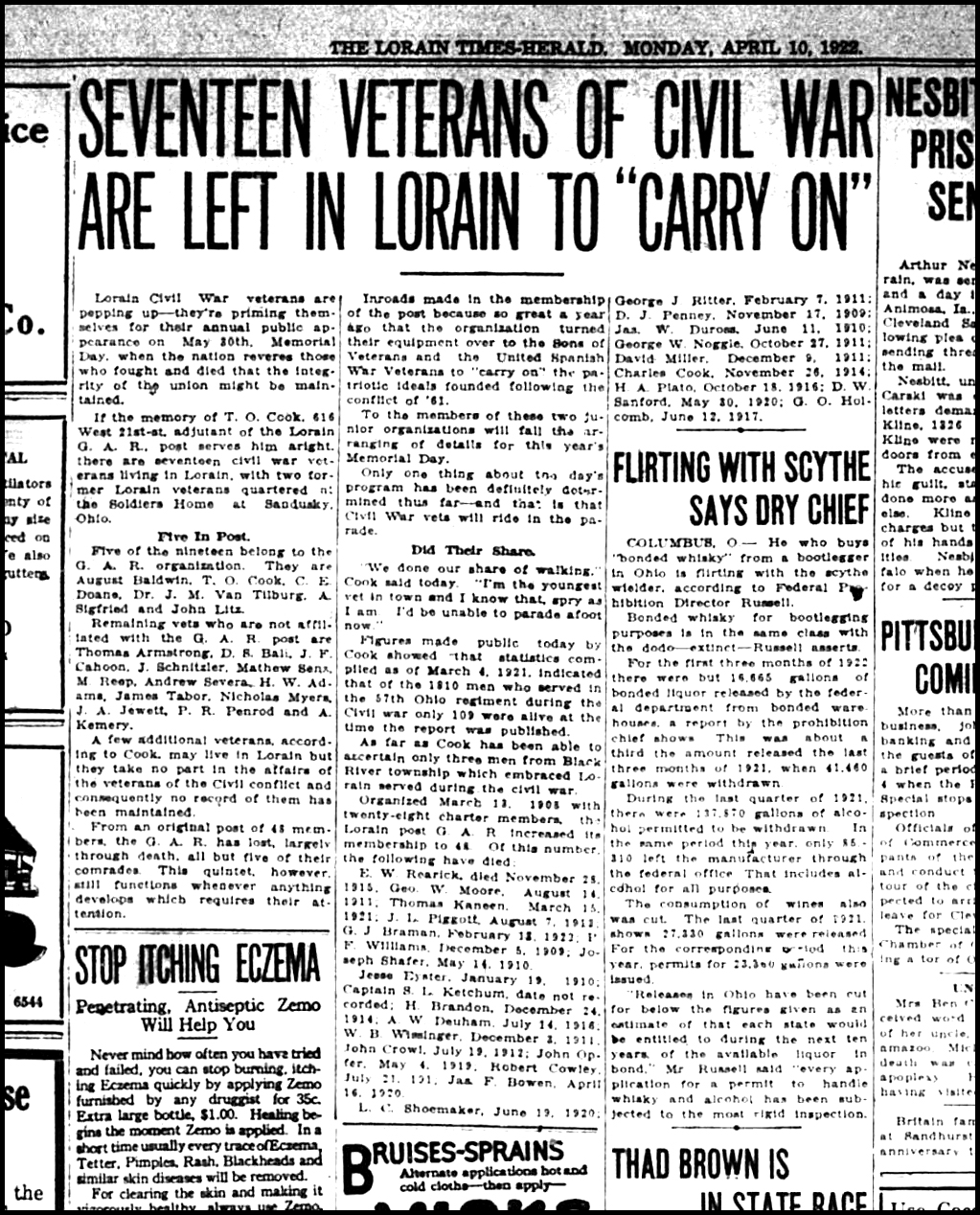
And if all of this talk about Civil War veterans interests you, here's a good article from the April 10, 1922 Lorain Times-Herald – a mere 100 years ago this month. It provides a nice snapshot of the surviving Lorain Civil War veterans at that time, when the war had been over for 57 years.


As the article notes, there were nineteen of them, with just six belonging to the Lorain Grand Army of the Republic organization: August Baldwin; T. O. Cook; C. E. Doane; Dr. J. M. Van Tilburg; A. Sigfried; and John Litz.


Those not belonging to the post included: Thomas Armstrong; Dr. S. Bali; J. F. Cahoon; J. Schnitzler; Mathew Senx (not sure if that is spelled correctly); M. Reep; Andrew Severa; H. W. Adams; James Tabor; Nicholas Myers; J. A. Jewett; P. R. Penrod; and A. Kemery.


As the article notes, there were a few additional local veterans that did not participate "in the affairs of the veterans of the Civil conflict and consequently no record of them has been maintained."