Friday, June 29, 2018

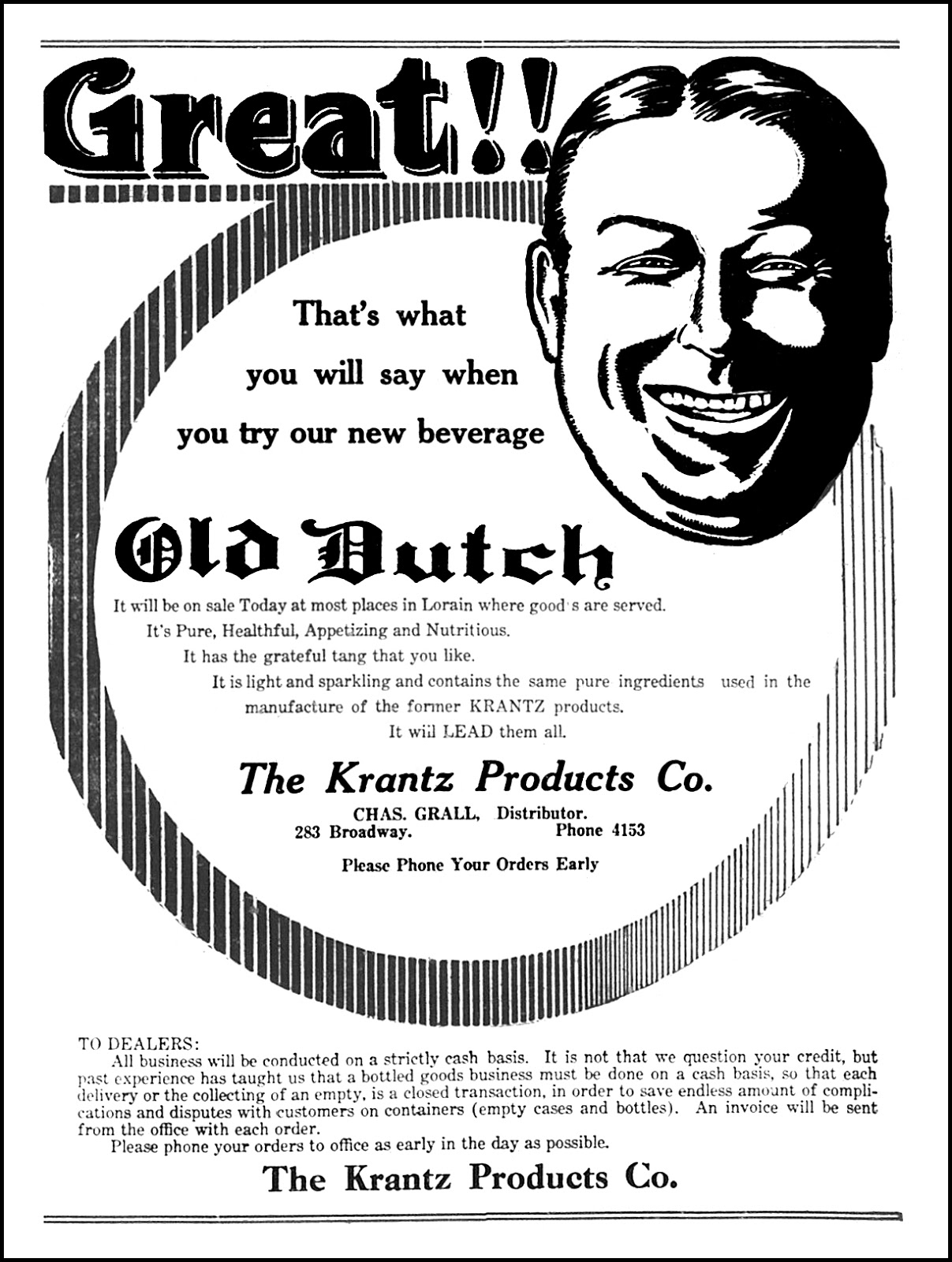
Old Dutch Beverage Ad – June 12, 1919

You probably noticed that the heading for this post said “Old Dutch Beverage” instead of Beer. That’s because the ad (from the June 12, 1919 Lorain Times-Herald) was promoting the Prohibition-era non-alcoholic Old Dutch beverage.

Old Dutch Beer – “The Good Beer” – was brewed in Findlay, Ohio at the Krantz Brewing Company and dated back to the early 1900s. The ’new' Old Dutch beverage was still made by the Krantz people (now called the Krantz Products Company) but was now promoted as “pure, healthful, appetizing and nutritious.”

I wonder why they didn’t just call it “The Good Beverage”?

Anyway, as long as we’re talking Old Dutch, I might as well post another ad that I recently found. This one is a little newer and is from the Lorain Journal of June 6, 1969 (below).

Maybe this campaign isn’t as clever as the ‘mangled syntax’ one, but at least it’s accurate. 
It was my father’s beer all right, and I did drink it eventually. My parents would bring me a six-pack when they visited me at my dorm at Ohio State.

****
UPDATE (June 15, 2019)
Here’s another ad from that 1969 campaign. It ran in the Journal on May 9, 1969 and probably served as the introductory ad to the new campaign.


Thursday, June 28, 2018

Jack LaVriha Looks at the Lorain Tornado – June 1958

Well, it was 94 years ago today that Lorain suffered its worst disaster – the 1924 tornado that claimed 78 lives and leveled much of the city.

The tornado’s horrible aftermath, however, brought out the best in the city and its residents as they quickly rebuilt the town – and their lives.

In observance of this infamous anniversary, here’s a well-written, late-1950s perspective of the tragedy by Jack LaVriha. It appeared in the Lorain Journal on June 28, 1958.

****
Tornado Dealt Tragic Blow
Here 34 Years Ago Today

By JACK LaVRIHA

Although most of the physical scars have been erased, many memories still remain of the disastrous and tragic tornado which swept Lorain 34 years ago today.

There are scores of men and women in and around Lorain who will recall the horror of that Saturday afternoon on June 28, 1924, when a whirling cloud of darkness enveloped the city.

The tornado swept over the north end of the city shortly after 5 p.m. and in less than two minutes took 78 lives, injured more than 1,000 persons and did property damage estimated at more than $25 million.

The tornado struck without warning after an exceedingly hot and sultry day. The terrific wind was accompanied by a heavy rain.

For more than an hour after the disaster tornado struck, Lorain lay stunned from the worst disaster in its history.

All public transportation was knocked out with street railway and railroad tracks twisted and wrecked. Electric power and gas plants were out of commission.

And it was impossible to communicate with the outside world because telephone and telegraph wires were down.

More than 1,500 homes were demolished, approximately 250 business properties were hit, nine churches were destroyed or extensively damaged, schools in the northern part of the city were damaged and industrial properties received heavy loss.

There were scores of dead, injured and dying in the wreckage and streets were filled with wrecked automobiles and debris of all sorts.

When darkness fell over the desolate community, word got out to adjoining areas concerning the catastrophe.

Immediately, an invasion of the city was made by doctors, nurses, ambulances, Red Cross and other volunteer workers.

The injured were taken to St. Joseph Hospital, hospitals in surrounding communities and to several Cleveland hospitals.

Lorain High School was converted into a morgue where bodies were taken for identification.

It took more than three months before the last of the communication lines was rebuilt and weeks before public transportation was resumed.

The tornado was followed by one of the biggest construction booms in Lorain's history. In many instances finer structures went up to replace those which were destroyed by the twister.

The scars of the tornado have been erased and a greater Lorain has arisen from the ruins left in the wake of the city's greatest catastrophe – which never will be forgotten.
Wednesday, June 27, 2018

Zsu Zsa at Benny's – June 1965

The incredible number of nightclub ads in old Lorain Journals from the 50s and 60s can lead one to only one conclusion: Lorain was a swingin’ town that liked the night life.

For decades, there was live entertainment available almost every night of the week. This was a real boon for area musicians and performers, who were able to make a pretty good living (or at least supplement their regular income).
And there were plenty of opportunities for the acts passing through Lorain as part of their national or regional tour too. 
I’ve featured a few of these acts over the years on this blog, including Woody Ernhart, who was appearing at Ben Hart’s night club on Broadway in January 1963.
Well, here’s an ad for another act – Zsu Zsa and the “Don’t Stop, Go” Revue – that appeared at a night club owned by Ben Hart (although this time it is the one located on West Erie Avenue, known at that time as Benny’s China Gate).
Here’s the ad, which appeared in the Lorain Journal on June 7, 1965. 
Although the ad for Zsu Zsa and the “Don’t Stop, Go” Revue – with five girls and four men – sounds like some kind of an orgy, it was nothing of the sort.
The book Catskill Culture: A Mountain Rat’s Memories of the Great Jewish Resort Area by Phil Brown provides a nice history of Zsu Zsa’s act. 
Brown’s parents worked at various resorts when he was a kid and he notes, “In addition to hiring acts, some hotels maintained resident entertainers, though not the huge social staffs of the early years. These acts would get free room and board in exchange for one show a week; the rest of the week they were free to play at other hotels. My own parents, always enticing relatives and friends to go the Mountains, even found people to fill this bill. Our friend Zsu Zsa had left Hungary after the 1956 rebellion, married Freddie Dawson in Canada, and wound up in North Miami Beach.
“Knowing that they were having a hard time getting their performing career off the ground, my parents arranged for them to come to Paul’s in Swan Lake around 1963 (remember, everyone was going to someday get their break in the Catskills). In their "Don’t Stop, Go! Revue,” Zsu Zsa played piano, Freddie played horn, both sang, and the difference was made up by a young drummer who also sang a little. These three entertainers, with their intense show business energy, could easily do a show of an hour and a half, and still have strength to drive to a later engagement or two.”
****
By 1964, Zsu Zsa and her husband had enlarged the act. An ad in the July 20, 1964 Anderson, Indiana Herald describes the act, which was playing Muncie at that time: “Lovely Zsu-Zsa and her Four Beautiful Dancing Girls Plus the Freddie Dawson Trio Playing for your Listening Pleasure. See the girls do the Twist – the Dog – Charleston.”
By the early 1970s, it appears that the “Don’t Stop, Go! Revue” had stopped and that Zsu Zsa was enjoying a new career.
An ad (at right) in the October 19, 1973 Montgomery, Alabama Advertiser revealed her new career as an artist, as she was appearing at an art show. It noted, "Zsu-Zsa Dawson was born in Budapest, Hungary. She is a graduate of the Artists Academy of Budapest. She took active part in the Revolution of 1956 and had to flee to Canada. She married Frederick Dawson, American artist and renowned musician. They toured the U.S. with their successful "DON'T STOP GO" Review. Currently, she is one of the top still-life artists in this country.


****
Just like when I wrote about Woody Ernhart, I was hoping to cap off my research with an interview with the performer. Sadly, (like with Woody), I was too late.

Zsu Zsa passed away in August 1, 2004 at the age of 74. Her online obituary noted, “A native of Budapest, Hungary, ZsuZsa studies at the Artist Academy were interrupted in 1956 by the Hungarian Revolution which she took an active part in before being forced to flee to Canada. She became known as one of the top still life artists and her work has been featured by Emile Valhuerdi Art Collection Corp., Ethan Allen Furniture Chains, Pearl Allan Galleries, Emporiums in the State of Washington, Canadian Artists of Toronto, Canada and Art E in Szentendre, Hungary.

“For the past 18 years she has been a teacher with the Dade County School System and is well known, sought after and very successful in her teaching profession.

Not bad for a gal who just happened to be singing and dancing on the stage at Ben Hart’s in Lorain back in 1965.


****
UPDATE (June 28, 2018)
Looks like one of Zsu Zsa's paintings could be on Ebay right now. It's down in Florida, which is where she lived.


Tuesday, June 26, 2018

Paul Henschke Sketches Lorain Landmarks – June 26, 1968

Back when summer vacation was really three months long (instead of ending in the middle of August like it does now), kids often didn’t know what to do with their time. Thus parents often found something for them to do.

One of the things that my parents did for my siblings and me in the summer of 1968 was to sign us up for art classes. These weekly classes sponsored by the Lorain recreation department were taught by well-known local artist Paul Henschke.

But it was much more than just drawing in a supervised environment. Mr. Henschke had a hunch that the Lorain of 1968 was not going to last forever; he knew that the cityscape was going to evolve. Consequently, for many weeks, the class met at various places around Lorain to sketch iconic sites. These included the Lakeview Park fountain and bathhouse; the back of the Broadway Building with its neon bowling sign; the Fire Station facing Washington Park; the Century Park bathhouse; the old City Hall.

Thanks to his foresight, those in his class who saved their drawings have a perfectly preserved view of many of the city’s landmarks from that era, as seen through a child. (I posted many of my drawings from the class in a three-part series that began here.)

Anyway, Mr. Henschke himself made a series of drawings of these very same landmarks. He explains his theory about preserving them through sketches in the article below, which appeared in the Lorain Journal on June 26, 1968.

He also makes reference to the art class he taught near the end of the short article.

****
I wonder whatever happened to Mr. Henschke’s sketches? It sure would be great to see them all framed and hanging in a row on the walls of Lorain City Hall.

Monday, June 25, 2018

Indian Fun at Willow Park – June 1968

Summertime triggers feelings of nostalgia for many adults, conjuring up memories of three months off with nothing to do but have fun (except for occasional yard work of course).

Like many kids who grew up on Lorain’s west side, my siblings and I played outside all day and found ways to amuse ourselves. We poked around in the former farmlands adjacent to our house on East Skyline Drive; we put on waterproof boots and explored what we knew as Willow Creek (much later we learned it was really called Martin’s Run); we played so much kickball in our backyard that we wore out the grass between the bases.

The City of Lorain did its best to help keep kids off the street by providing a summer recreation program that included some special events. One of the most memorable was an Indian-themed day of fun at nearby Willow Park.

Read all about it in the article below, which appeared in the Lorain Journal on June 21, 1968.

****

‘Hostile Indians’ Invade Lorain Park
By JERRY WALKER
Staff Writer

More than 400 young Lorain cowboys and Indians from 18 summer recreation parks around the city took a hike along the “Western Trails” yesterday at Willow Creek Park during the first of the parks special program days.

Yesterday’s event began at 10:30 a.m. and finished at 4 p.m. with all 18 parks sending a group. Each group was taken through the trail at 30-minute intervals.

THE HIKE STARTED at the cardboard Fort Willow. Trailmasters Donna Bialik and Pat Lenard (Willow Creek Park advisors) said “On your right is Fort Willow, it will probably be the last friendly place you will see for quite a while.”

From there the trail wound around with Indian drums beating in the distance through the woods and high grass along the creek bank past cardboard animals and rubber spiders and snakes. The next stop was the gold rush area where the “prospectors” searched for gold nuggets (repainted rocks) in the grass. The gold could be traded to a good looking Indian squaw (Barb Toth) and her Indian brave sidekick (Tim Breeden) for grits (bags of candy).

After passing out the bags of candy (everyone got one with or without gold) the war-painted squaw warned, “You may continue but beware of Indians ahead. They might attack you in an ambush. Go now but beware.”

THE HIKE STARTED again and the group was promptly attacked.

At the trail’s end was the “Tradin’ Post,” run by Nance Braun and Barb Paskavan, where candy and punch could be purchased. “You can tell the kids are ‘diggen’ this event because the Tradin’ Post needs to resupply for the afternoon group” said one of the “wild” Indian braves.

Mrs. Miriam Snyder, superintendent of recreation, also was pleased with the turnout and the reaction of the kids. "Things went smoothly mainly because of our good crew of workers,” she said.

JUDY EISENHARDT, a member of the committee for playground advisors, said “the kids are real happy and we had a big turnout today. Our next event is next Thursday at Central Park. It will be a tea party for girls starting about 1:30 p.m.”

****
I remember that day at Willow Park, mainly because of the Indians theme and the terrific park staff. The workers did a great job of bringing the fantasy to life in a fun and non-threatening way.

My most vivid memory was of the hike through the woods and the Indian attack. That’s because one of the marauding Indian braves scooped up a kid in our group, and ran off with him for a short distance.

It was all a lot of innocent fun on a summer day in Lorain in the 1960s.

Friday, June 22, 2018

Up With People – Lorain International Festival 1968

Full page Lorain Journal ad from June 24, 1968
Photo from June 29, 1968 Lorain Journal
Well, it's Lorain International Festival time again!

Fifty years ago, an appearance by Up With People kicked off the Second Annual International Festival with two performances at Admiral King High School.

What's Up With People? It's a group of young people who travel the world in an effort to make it a better place, spreading peace, good cheer and hope through their inspirational music and positive action.

Read all about it in the Journal article below, which appeared in the paper on June 27, 1968, two days before their Lorain show. The article by Rich Bloom contrasts the “Up With People” cast with the hippies that were so prevalent then.

****

'Up With People' Crew Sings 
To Make a Better World

By Rich Bloom
Staff Writer

TUESDAY NIGHT a group of "hippies" invaded and took over a radio station in New York, shouting obscenities to hundreds of viewers never before heard over the air.

MEANWHILE, in the same city – 180 hard-working young men and women – members of the internationally known "Up With People" cast – were busily preparing a variety of songs for their Lorain debut on June 29.

The two groups are entirely different in actions, speech and philosophies.

WHEREAS the "hippies" protest, hoping to change the world, the "Up With People" members sing out what they're for, doing their part to change world attitudes.

WHEREAS the "hippies" try to find a new world through LSD and "pot," the "Up With People" young adults attempt to point out why there's really no need to find a new world.

They are clean, wholesome and they believe in honesty, purity, truth and love.

Even though these differences are clearly delineated, many people still tend to judge today’s youth solely on the actions and speech of the “hippies.”

This widely publicized contingent of bearded draft-card burners is constantly in conflict with the purpose bend the “Up With People” philosophy – to change the image of today’s youth and at the same time try to mold new attitudes and ideas for future generations.

THROUGH SONGS such as “Freedom Isn’t Free” and “The World is Your Own Hometown” the young men and women are striving continuously toward their goal, and in the past three years have spurred many other young people along the same path.

The cast will present, in concert, these and other songs when they appear in Lorain for two concerts leading off the city’s Second Annual International Festival.

Inspiring music will be the keynote when the energetic cast burst onto the Admiral King High School stage, both Sunday and Monday nights at 8 p.m.

Sales of tickers for the concert, priced at $1.50 for students, $2.50 for adults and $3.50 for a limited number of reserve seats, are reported as “good” and are still available at the following locations:

The Journal

All Lorain Banks and their respective branches

The Lorain County Savings and Trust Co. branches at the Midway Mall and Amherst

LORAIN AREA families have opened their hearts warmly and enthusiastically, providing accommodations for the entire cast, scheduled to arrive in Lorain Saturday afternoon.

****
By the way, Up With People is still around. Here’s the link to its website.

Thursday, June 21, 2018

The Passing Scene – June 1968

There's only three "The Passing Scene" strips that ran in the Lorain Journal in June 1968. But what's strange is that cartoonist Gene Patrick only drew two of them!

Here's the June 1, 1968 edition, which shows Gene at his prime. There's a funny gag involving midges (those pesky lake bugs that look like mosquitoes) and two panels that feature well-drawn shapely gals. And the first panel (with a guy about to be tarred and feathered) is pretty funny too.

Next up is the June 15, 1968 strip, which innocently pokes fun at a Japanese visitor to the Ridge Tool headquarters in Elyria (but in a way that is considered racist and unflattering today). 
And lastly, here is that strip drawn by someone else, which ran in the paper on June 22, 1968. Maybe Gene just wrote the gags but was too busy to illustrate them.
While the 'guest artist' was certainly talented, the gags simply don't work as well. It shows how critical Gene's clean, simple, cartoony style was to the humor of the strip.
In the past, I've posted "Passing Scene" strips from the 1970s that Gene drew, so perhaps this was a one-shot deal. We'll see next month.