Monday, February 22, 2021

Green Acres Home – Feb. 3, 1971

Mention the phrase 'Green Acres' to any Baby Boomer, and they would probably think of the 1960s rural comedy featuring Eddie Albert and Eva Gabor as the city couple that moved to a farm in Hooterville (where they encounter an endless parade of goofy locals). 

But did you know that 'Green Acres' was also the name of the Lorain County children’s home?

According to a history page on www.childrenservices.org, “In 1898, the voters approved a measure authorizing the Commissioners to build a children’s home.

“The Commissioners purchased 15 acres (at the corner of Oberlin Rd. and E. College St.) for $3675, and the Green Acres Children’s Home was built at a total cost of $32,500.

“Three siblings, ages 6, 8, and 12, were the first children placed there on August 4, 1900. 445 children had been admitted in the first 10 years. 411 of them were subsequently placed elsewhere. Family breakdown was the main reason for placements. A few were orphans, but most were placed due to "drunkenness or infidelity” of parents. The original Children’s Home was capable of housing 65 children at any given time, and during World War II there were as many as 100 housed at a time. The garden, poultry, and fruit trees were depended upon to help feed the children, and the children provided much of the labor to keep them going, and heating fuel was provided by two gas wells on the property.

“In 1969, with a campaign of “Once in 70 Years” the voters approved a special levy to replace the old Green Acres Children’s Home with a modern one."

The article at the top of this post, which appeared in the Journal on Feb. 3, 1971, notes that the new children’s home would provide 18 additional beds for children between the age of 6 and 18. 

It’s interesting to see an actual photo of the original Green Acres Children’s Home after hearing about it for so long.

****

By the 1990s, it was no longer cost-effective to operate Green Acres, and according to www.childrenservices.org, the facility was becoming too impersonal and lacking in the home atmosphere that children need. The facility closed in 1995 and was returned to the County Commissioners.

The city of Oberlin acquired the former Green Acres Children’s Home site in 2011 and contracted for the demolition of the buildings in order to redevelop the property.

****
UPDATE
Here's a great full-page story about Green Acres Children’s Home written by Doug Warren that appeared in the Journal on October 27, 1965.


Sunday, February 7, 2021

Blog Break!

I’m going to be taking a little break from blogging. Sorry about that, Chief.

Devoting the necessary attention to some personal matters is going to completely tie me up for the next few weeks, so I’ll have very little time to create content, or even monitor the blog comments for that matter. I’ll have the odd pocket of time here and there, but not having to think about the blog will make things much, much easier for me.

Rest assured I’ll be back as soon as I can.

Friday, February 5, 2021

Journal Ad Featuring Dennis the Menace – Feb. 12, 1971


Here’s an cute ad that the Journal ran back on Feb. 12, 1971. The nearly 3/4 page ad promoting the newspaper itself features the comic strip character Dennis the Menace.

The tousle-haired tyke had first appeared in the pages of the Journal back in 1955 (which I wrote about here). The popular one-panel strip enjoyed a high profile location right at the bottom of the editorial page for years.

The ad is interesting because it mentions a few of the things that made the Journal special back then, including syndicated columns such as Ann Landers and Art Buchwald, as well as the great local features, such as Bill Scrivo’s People, the Hot Line help column, reporter Jim Mahony’s column, etc. Unfortunately, too many papers have had to cut their staffs in order to save costs and stay afloat.

I really think newspapers such as the Journal today really need to bring back those kind of special local features and columns, if they want to have any chance at all of rebuilding their circulation numbers.

Thursday, February 4, 2021

City Bank Ad – Feb. 1, 1971

Here’s a great example of how much advertising changed in only a few short years to reflect the massive cultural shifts taking place in American society in the early 1970s.

The City Bank ad above, which appeared in the Journal on Feb. 1, 1971 seems almost unrecognizable from campaigns from only a few years earlier, with its use of a modern, up-to-date graphic designed to appeal to a youthful customer.

There’s the ‘groovy’ type; the use of the drug-related phrase ‘Turn On’ as part of a slogan; and illustrations of people that include some of the ‘hip’ new hairstyles and clothing. Ugh.

It’s a long way from this competitor bank’s ad of only a couple years earlier. It may have been corny to some, but it caught your attention and drove the point home.
For me, advertising largely stopped being interesting beginning in the 1970s because of the change in selling tactics. Too often, the new campaign objective was to make the consumer feel that he had to buy or use a product to be ‘cool’ – instead of selling the product’s attributes in a fun or clever way.

Wednesday, February 3, 2021

Bob Beck Chevrolet Ad – Feb, 1, 1971

Remember my post from early December about the out-of-state gentleman looking for a vintage Bob Beck Chevrolet keychain? 

He had purchased a 1965 Corvette that had originally been delivered to the Bob Beck dealership in Lorain, and thought that it would be nice to have a Bob Beck keychain to go with it.

I told him that the search for a keychain would have been a lot easier in the 1970s or even the 80s, rather than fifty years later. But after some detective work, we may be closing in on one. I’ll let you if and when it happens. 

In the meantime, here’s a nice Bob Beck ad that ran in the Journal on Feb. 1, 1971. Although Bob had passed away in February 1970, the dealership knew the power of his name was still strong. I like the tagline: “A Name That Means A Great Deal.”

Maybe someone connected to one of the men pictured in the ad (including Roger Noak, Buzz Gibson, Frank Camera, Ron Crowe, Roth Garrett, Darwin Harmon, Ron Kokinda, Joe Krall, Dewey Mann, and John Mitchell) has an old keychain or other piece of dealer memorabilia in their junk drawer.

The funny thing is, after looking at this ad, I remembered that my parents bought a used 1970s Chevy Impala for my sister to drive. (I don’t remember what Chevy dealer’s name was on it.) It was the rare used car they bought that wasn’t a Cutlass.

That Impala was huge – about as big as the boat-like 1963 Buick LeSabre that we later drove to Admiral King High School.

****

All this Chevy talk reminded me that your humble blogger posted what is probably the only image on the whole internet of the cartoon caricature of Commander Ray of West Park Chevrolet.

Tuesday, February 2, 2021

Happy Groundhog Day!

This isn’t Phil; it’s an anonymous groundhog
in Shenandoah National Park
Hey, this isn’t Phil either. It’s just some
Wisconsin groundhog.
Longtime readers of this blog may feel like they’re experiencing their own Groundhog Day time loop as they read today’s post. 

That’s because as usual, I’m posting some vintage postcards and reviewing some of Punxsutawney Phil’s forecasts of the past as reported in the Journal.

We’ll start out on Groundhog Day 1961 – sixty years ago today – which fell on a Thursday. It had been pretty frosty in Lorain, with a low of 4 degrees forecast for that night. (I hope everyone took Reddy Kilowatt’s advice back then and bought one of those newfangled “electric bed coverings.")

While the Groundhog forecast made the front page that year, the article curiously neglected to name which furry meteorologist was doing the predicting. 

At least the Journal gave Mr. Groundhog’s forecast priority on the front page over a rather boring article about the possibility of nuclear war being triggered with the push of a button.

Ten years later on Groundhog Day 1971, Lorain was once again in the icy grip of Old Man Winter. This was the Journal front page article the day before. 
(Note that the cute photograph was taken by our man Gene Patrick. He had a real rapport with young people – in this case, Lorain High School students Colleen O’Brien and Brian McNulty.)
Unfortunately, Punxsutawney Phil didn’t make the front page that year. His forecast (six more weeks of winter, what else?) was buried like an ill-tossed Journal in the snow at the bottom of the Page 2 article about the weather.
Anyway, here’s hoping you have a fun and safe Groundhog Day!

****
For more Phil-related Phun, er, fun, why not visit some past Groundhog Day posts?
****
UPDATE (Feb. 3, 2021)
Here’s a screen grab of Phil yesterday as the members of the Punxsutawney Groundhog Club read the "six more weeks of winter” prediction from the scroll. Phil looks kind of ornery!

Monday, February 1, 2021

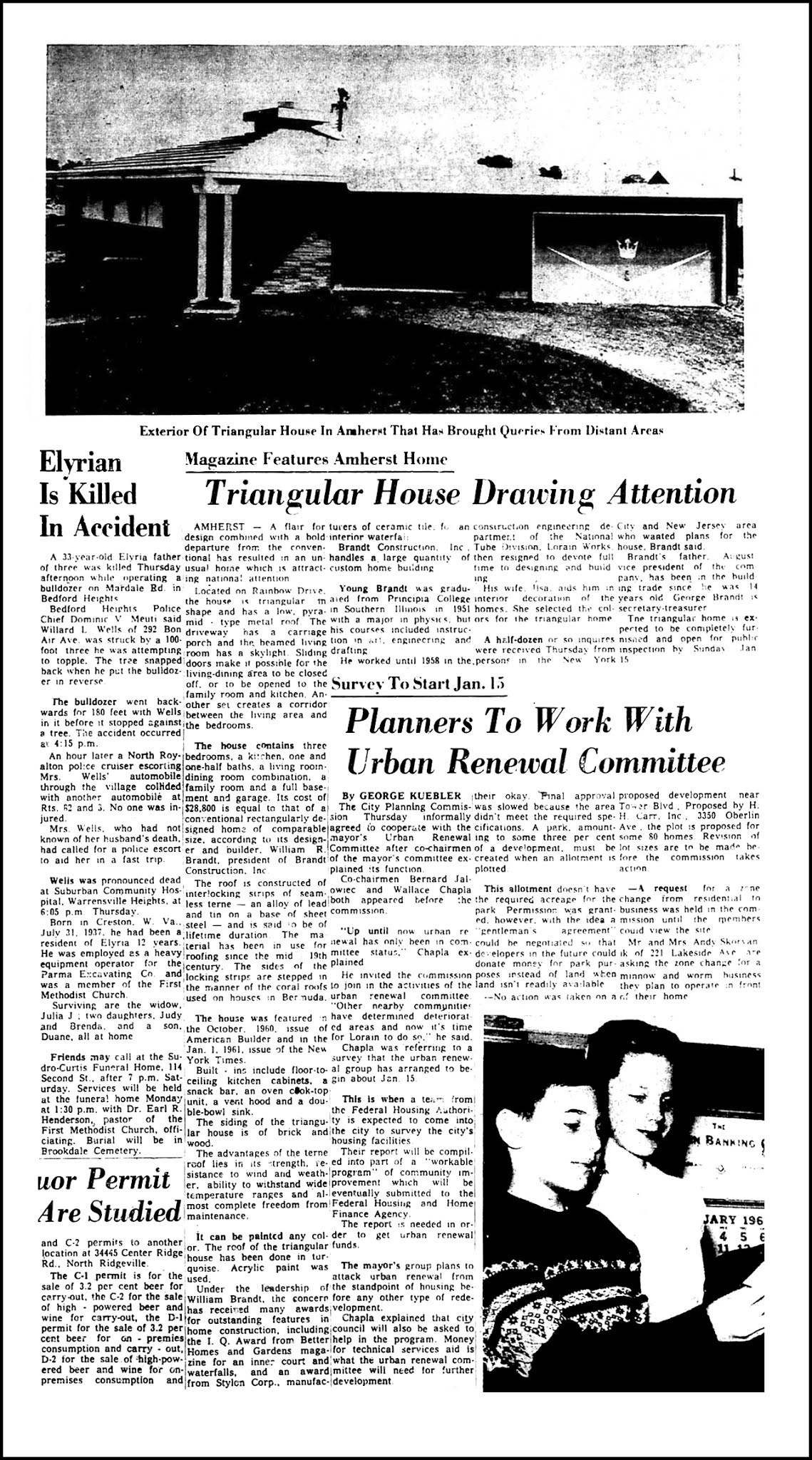
Amherst’s Triangular House Gets National Attention – 1961

Did you know that a home in Amherst was featured in the October 1960 issue of American Builder, and the January 1, 1961 edition of the New York Times because of its unusual design?

The house is triangular in shape and is still located on Rainbow Drive. William E. Brandt, president of Brandt Construction, was the designer and builder.

Read all about it in the article below, which appeared in the Lorain Journal on Jan. 6, 1961.

Here’s the floor plan and a photo, courtesy of the Lorain County Auditor website.

Curious enough to drive over there and take a look? With the weather the way it is, let’s go for a convenient Google Maps drive instead.
Its good to see that the house retains its original early 60s charm.