Friday, July 17, 2020

July 1942 – Wartime Reddy & Speedy

It’s been a while since I featured our two utility mascot pals – Speedy for Ohio Fuel Gas Company, and Reddy Kilowatt for the Ohio Public Service Company (later known as Ohio Edison).

To remedy this egregious oversight, here they are in a pair of wartime ads that ran in the Lorain Journal and Times-Herald on the same day: July 11, 1942.

Here’s the Ohio Fuel Gas Company ad. In this ad (which would probably be considered politically incorrect today), a man flame is shown operating a machine that cranks out bearings, while a female flame is canning fruit.

As you can see, Speedy was still evolving; it would take several more years before the various flame characters featured in the ads would be consolidated into just one mascot: Speedy.

Reddy’s ad promotes electric power for defense or for homes, but cagily sidesteps any sexist issues.

Reddy is still a little rough looking at this point in his career as well, with his beady eyes and ‘shockingly’ skinny frame.

Fortunately, both mascots would get makeovers in a few short years, making them more likable and guaranteeing them long careers as ‘power players’ in their respective utility company fields.

Thursday, July 16, 2020

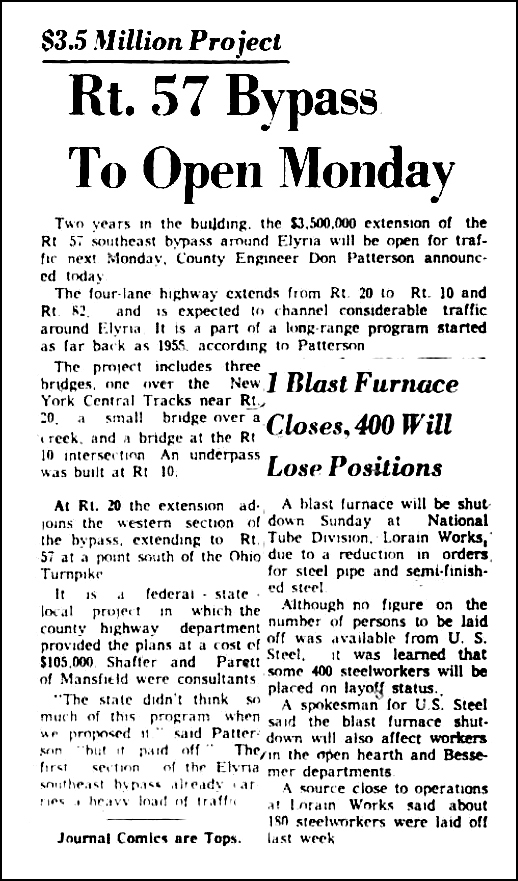
Route 57 Bypass Completed – July 1963

This post is for anyone who ever drove around Lorain County and wondered when a particular segment of highway was built.

The above below, which appeared in the Lorain Journal on Thursday, July 25, 1963, notes that the  extension of the bypass around Elyria was going to be open for traffic the following Monday.

The article noted that the bypass project had dated back to 1955. Apparently this was the final piece of the puzzle, extending from U. S. Highway 20 south to Ohio State Route 10.
Here’s a 1960s map showing much of the just-completed extension of the bypass.
While it’s great to be able to take these bypasses if you’re in a hurry, channeling traffic around a city via high-speed expressways wasn’t such a good idea for its local economy. 
But with an incessant ’need for speed,' that’s what this country focused on after World War II with the construction of the Eisenhower Interstate System and various limited access state highway projects. We see the sad results today in cities today (such as Lorain), where most of the new commercial development is out by the highway exits.

The Route 57 Bypass, looking east towards the intersection with Furnace Street

****
UPDATE (July 22, 2020)
One commenter was wondering what the area in the photo looked like before the bypass was built. Here are a few aerials from the Historic Aerials website, along with a map of the same area today for street name reference.
1952
1962
1969
Today

Wednesday, July 15, 2020

Mail Ma’am – July 6, 1968

When it comes to the delivery of the U. S. Mail, there have been female mail carriers since the 1800s (according to this Wiki entry).
But when I was growing up in Lorain in the 1960s, I don’t think it was very common. The mailman who walked our route was usually a tanned, older man, wearing a uniform. In the summer, they usually adopted the safari look with a pith helmet.

It seems to me that it wasn’t until much later that many of the carriers walking around the city were women. I could be wrong.

Anyway, the spectacle of a young, attractive female mail carrier (even if she was just a summer employee) was apparently unusual enough to warrant a photo, as seen above in the item that appeared in the Journal on July 6, 1968. Marie Cunningham was the junior from Bowling Green University helping out for the summer.

I know – the photo and caption are a little politically incorrect by today’s standards. But it was all in fun in a much more innocent time.

Tuesday, July 14, 2020

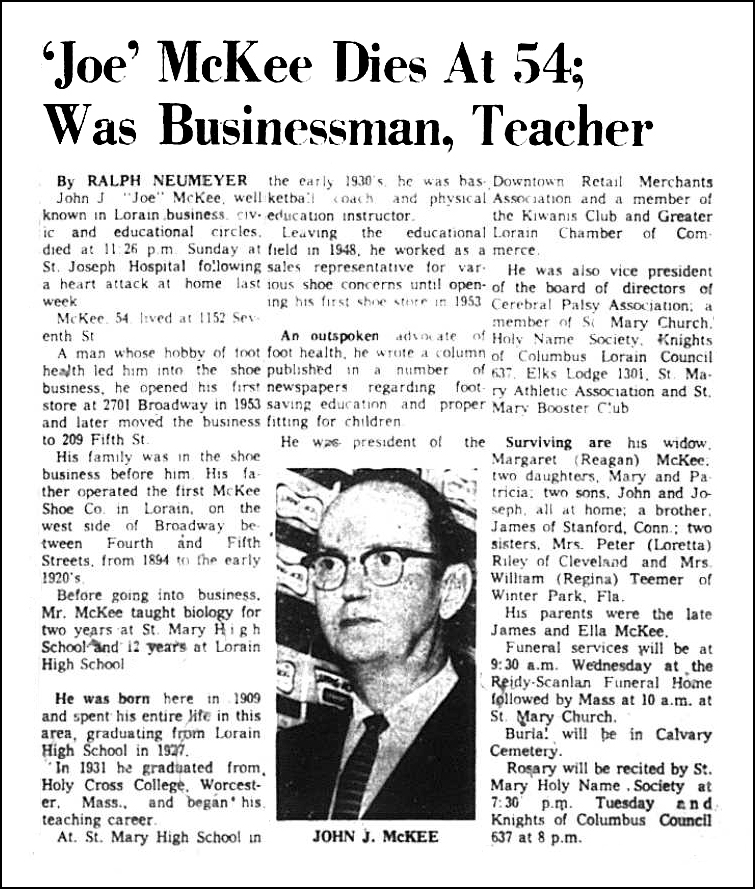
John J. McKee Passing – July 1963

Ask anyone who grew up in Lorain to name a family-owned shoe business and they’ll probably mention the well-remembered Januzzi’s store located on Broadway, and later out at the Sheffield Shopping Center.

But there was another longtime local shoe store that shouldn’t be forgotten: McKee’s.

John J. McKee was the man behind the store store. The article above, which appeared on the front page of the Journal on July 15, 1963 at the time of his passing, provides a short history of the McKee shoe business and John McKee.

“A man whose hobby of foot health led him into the shoe business, he opened his first store at 2701 Broadway in 1953 and later moved the business to 209 Fifth St.

June 1919 ad from
Lorain Times-Herald
“His family was in the shoe business before him. His father operated the first McKee Shoe Co. in Lorain, on the west side of Broadway between Fourth and Fifth Streets, from 1894 to the early 1920’s.

“Before going into business Mr. McKee taught biology for two years at St. Mary High School and 12 years at Lorain High School.

“He was born here in 1909 and spent his entire life in this area, graduating from Lorain High School in 1927.

“In 1931 he graduated from Holy Cross College, Worcester, Mass., and began his teaching career.

“At St. Mary High School in the early 1930s, he was basketball coach and physical education instructor.

“Leaving the educational field in 1948, he worked as a sales representative for various shoe concerns until opening his first shoe shore in 1953."

Monday, July 13, 2020

How Lorain Got Its Name

Back in July 1918, we were a little more than a year into our involvement in World War I. Not surprisingly (except for the spelling), “DISTROY HUN ARMY” IS AIM OF ALLIES” is the headline of the July 31, 1918 edition of the Lorain Times-Herald.

Besides the war stories, there’s plenty of interesting things on the page. Employees of the National Tube  Co. were about to receive a wage increase of 10 percent; the first coke was about to be drawn from the new ovens at the National Tube plant that day; the earnings of United States Steel were ‘greatest in history; and the Elks enjoyed turtle soup at their hall on Tuesday night.

But what caught my attention was the small article about how Lorain got its name. It’s a nice little explanation for anyone who has never heard the explanation.

“How did Lorain get its name?” asked the article. It noted, “That question is asked often these days when the province of Lorraine in Europe figures so prominently in the news dispatches and when there is some talk of changing the city’s name to adopt the french spelling.
“The city took its name from the original Lorraine.
“It was named from the county of Lorain by Judge Heman Ely from whom Elyria took its name.
“The judge had traveled in Lorraine and was so impressed with its beauty that he decided to name the county in which he controlled the land for the beautiful French province.”
The article goes on to note that when the village of Charleston had to come up with a new name (as ‘Charleston’ was already taken), it was the late Charles S. Vorwerk who had suggested naming the village ‘Lorain’ after the county.
Vorwerk’s suggestion was a clever idea (though perhaps a wee bit weaselly). It gave Lorain a charming name, as well as prominence as the namesake port city in the county, and cemented Vorwerk's fame as one of the incorporators of the city when he passed away in 1914.

****
UPDATE (July 22, 2020)
The above article explains how Lorain got its name, but as we shall see, it’s not exactly clear how the county got its name.

What am I talking about? Well, I recently received an interesting email from a regular reader of this blog who is also a local historian. 

"I just noticed that you recently blogged the old legend about the origin of the county’s name, he wrote. "I guess you were unaware that the originally proposed county name was apparently “Colerain.”"

He noted his source was an 1822 Sandusky newspaper, and that this is also observed on the Lorain County Wiki entry. 

This was all new to me. But the November 13, 1822 issue of the Sandusky Clarion does include a mention of the Ohio General Assembly’s plan "for a new county to be set off from Huron, Medina and Cuyahoga to be called Colerain."

The name “Colerain” apparently comes from Coleraine, a town in County Londonderry, Northern Ireland. It’s a popular name in Ohio, with Colerain Townships located in Hamilton, Belmont and Ross Counties. There’s also a community in Belmont County.

So did Lorain County get its name because the name “Coleraine" was already being used in other parts of Ohio for townships as well as a community? It’s a good question that I can’t answer.

The reader who pointed all this out to me also poked some holes in the Judge Ely naming story. He made the observation that ‘Lorain’ is not pronounced the same way as ‘Lorraine,’ the French province. “Lorraine is spoken more like we would say ‘Lorenna’ with a very soft “a,” almost imperceptible,” he noted.

“It kind of dishonors the place in France which it is supposedly named in honor of, being that it is both misspelled and mispronounced,” he humorously observed.

Anyway, how Lorain County really got its name is a pretty good mystery that someday will hopefully be solved.

Friday, July 10, 2020

Stars & Stripes Forever – in My Brain

Little did John Philip Sousa know that his iconic
“The Stars and Stripes Forever” would be used to sell cereal
Over the recent July 4th holiday, a chance encounter with a John Philip Sousa march on TV reminded me just how deeply our memories are linked with television.

The tune was “The Stars and Stripes Forever,” and during one part of it, I found myself mouthing lyrics that included the words, “...and all sorts of craa-zy shaaaapes.”

“Where did that come from?” I wondered. I knew it was some old TV commercial that I had seen as a kid but I had no idea what product it was. But it showed how savvy the advertising agency was that produced the commercial, because it was still stuck in my subconscious a half-century later thanks to the iconic music.

I knew this was going to bug me until I figured it out.

I had a hunch that it might have been cereal. What other product came in a bunch of different shapes? And I was also guessing that there were other people out there who remembered the commercial as well.

It didn’t take too much Googling to find out what product it was.

On the “Memorable advertising jingles for defunct products” on the Straight Dope Message Board, I found my answer: Post Alpha Bits!

The whole ‘crazy shapes’ thing was part of a temporary promotion in the mid-1960s during which pieces of cereal shaped like stars, planes, etc. were mixed in with the usual letter-shaped Alpha Bits pieces. It’s a strange idea that would seem to dilute the special quality of the brand – so maybe that’s why the gimmick didn’t last. (The cereal is still around, however.)

Courtesy TheImaginaryWorld.com
Anyway, there were a couple Alpha Bits commercials with the “Stars & Stripes Forever” music during the promotion, so it’s not surprising that it was imprinted on my brain. You can see them (and possibly get it stuck in YOUR head) in this YouTube collection of POST cereal commercials. There’s also one for the V-RROOM engine cartoon contest that I wrote about here.


I probably have dozens of other obscure cereal commercials rattling around in my brain (such as the one for the Quaker Puffed Cereals that used the 1812 Overture as background music). But it’s nice to know that I’m not ‘crazy’ when it comes to remembering this one.

****
To hear “The Stars & Stripes Forever” in all its glory and learn the story behind it too, visit this link on the Marines website. Or, play it on YouTube below.

Thursday, July 9, 2020

Great Nest of Brownhelm Rises Again

The actual Great Nest
(Photo courtesy
National Geographic)
The staff at Lorain County Metro Parks has been working on a construction project down in the Bacon Woods area at Vermilion River Reservation that’s definitely not for the birds: a reproduction of the Great Nest of Brownhelm.

The Great Nest of Brownhelm was the famous American bald eagle nest that was located on Lake Road, halfway between Vermilion and Lorain. It was the largest known bird tree nest before it fell in a storm in March 1925. 

I did a comprehensive history of the Great Nest back here. The blog post included rare photos from the elusive issue of National Geographic from May 1929 that featured Professor Francis H. Herrick and his eagle research over the years.

The Metro Parks’ reproduction nest is not officially done yet (the construction scaffolding just came down on Tuesday), but it’s quite wonderful to see, with the meticulous attention to detail.

I’ve been watching the nest take shape over the last few weeks, as I’ve passed it during my almost-daily walks on the trail there. At first I thought it was some kind of crazy treehouse, but soon I realized something special was going on and a small sign confirmed it. The sign noted that this new version of the Great Nest replaces the other reproduction that was on display at Carlisle Visitors Center.

Anyway, congratulations to the talented staff of Lorain County Metro Parks for a job well done.

By the way, Lorain County Metro Parks recently installed attractive new signage at both Mill Hollow and Bacon Woods. It looks great!