Tuesday, March 6, 2018

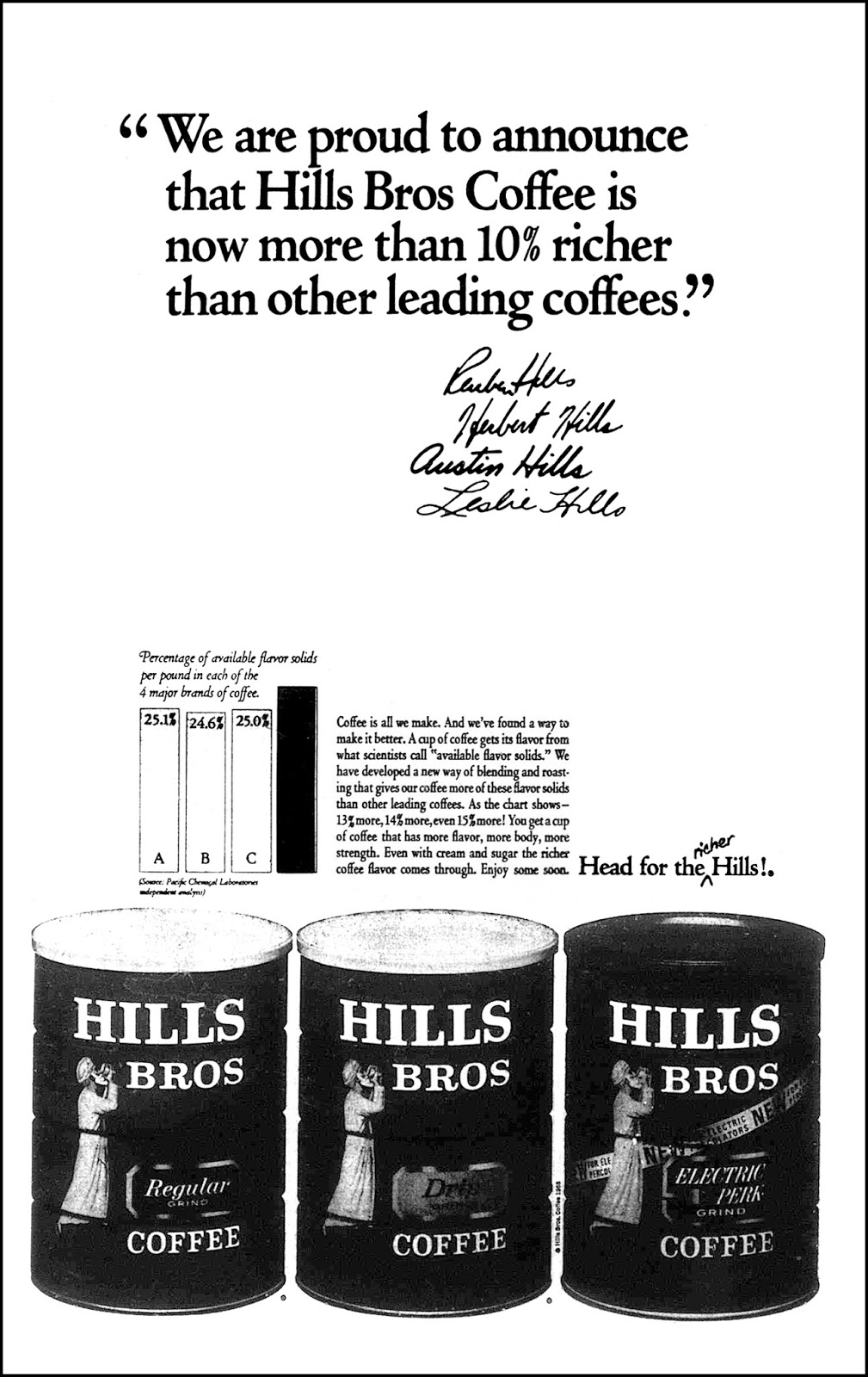
Hills Bros. Coffee Ad – March 5, 1968

Yesterday's blog featured a Cutlass ad that may very have helped define my parents' choice of cars (assuming that they were susceptible to newspaper advertising).

Continuing that line of reasoning, here's an ad that may have led to Mom and Dad choosing Hills Brothers as their all-time favorite coffee.

The ad – which took up 3/4 of a page – ran in the Lorain Journal on March 5, 1968 – 50 years ago this week.

Mom and Dad were super loyal to Hills Brothers. For decades, it was the only coffee they ever drank. When it was on sale at Marc's, I would pick up three or four cans for them. Once, they had thirteen cans of it in the cupboard!

(I always thought Hills Brothers was pretty good, and it probably helps explain why I'm not a coffee elitist today. However, now I drink Tim Hortons coffee – the choice of millions of Canucks – each morning.)

Interestingly, Hills Brothers was one of the few coffees with an actual advertising mascot. In this case, the turban-wearing coffee drinker was known officially as the "Taster." (The iconic figure is immortalized in the form of a bronze statue, which you can read about here.) I think he gave the can a lot of character.

Here he is as part of a vintage easel-backed point-of-purchase display, courtesy of liveauctioneers.com.
Unfortunately, the coffee-sipping Arab was 'canned' in the 1990s.

The reasoning behind his retirement is explained in this interesting article. The article also reveals that the brand is now enjoying increased popularity nationwide because of a recent redesign of the packaging.

And here's a link to a whole Pinterest page devoted to Hills Brothers coffee packaging, signage and history.

****
What’s your favorite coffee?

Do you like it brewed the old-fashioned way, where you open a can (or bag) and scoop it into a basket/filter? (To me, smelling that ground coffee is the best part!) Or are you a pod person?

Be sure to leave a comment!

Monday, March 5, 2018

Crazy for the Cutlass

Here’s an ad for the Oldsmobile Cutlass that may very well have had a big impact on my parents. It ran in the Lorain Journal on March 5, 1968 – 50 years ago today.

I’ve mentioned before how my parents were loyal Oldsmobile customers. But the Cutlass would eventually be their favorite car of all time.

They started their long-running Olds connection with a new 1963 F-85 as the family car. But when we began to take cross-country family camping trips – towing a fold-up trailer – a bigger car was needed.

Thus the F-85 became Dad’s work car, and my parents purchased an Olds Delmont 88. They didn’t keep it for very long, since it didn’t have air conditioning and we were planning a major trip Out West. So they got rid of the Delmont and bought a Delta 88. That car was still one of the smoothest-riding cars I’ve ever been in. It felt like you were floating while riding in it.

Meanwhile, a variety of cars had served as transportation for us kids. We had inherited Grandma’s 1963 Buick LeSabre, which my older brother drove to Admiral King High School. We also had a used early 70s Chevy Impala which my sister drove to LCCC.

So eventually we needed another used car, and the choice was a 1971 Cutlass with bucket seats. It was the first of many used green Cutlasses, many of them purchased from Milad’s in Amherst.

Over the next six or seven years, a variety of used, green Cutlasses graced the Brady driveway. Looking back, I think we had almost every model year from 1968 to 1973 represented. (I think we were missing a 1970 in there.)

The Cutlass with a built-in maraca that I drove
during my senior year at Admiral King 
When my Dad got rid of his F-85, he replaced it with a used 1968 Cutlass. My parents also bought a used 1969 Cutlass (with cool mag wheels) from some teenage shyster. It turned out that the driver’s side window had been broken at some point, and the door sounded like a cheap maraca when you opened or closed it. It also leaked broken glass out of a small hole in the door. But I happily drove it during my senior year.

We also had a 1972 Cutlass (green – what else?), purchased from one of my mother’s co-workers at U. S. Steel. That was the last of the green ones; my parents had moved on to a 1973 burgundy Cutlass Supreme. (They later had a Cutlass Ciera.)

The 1972 Cutlass lasted the longest. It went down to Ohio State with us, and when my younger brother finished college in the early 1980s, the Cutlass came back to Lorain. I bought it from my parents and held on to it for a few years out of pure nostalgia, but it was too difficult trying to keep two used cars going. The Cutlass also had a nasty habit of conking out unexpectedly when I least expected it.

One story I like to tell is how I was living at the Overlook in the mid-1980s with two cars – the 1972 Cutlass and a 1976 Buick Skylark. It was winter, and I was heading out to a big band gig. (I think it was New Year’s Eve 1984.) I wanted to take the Skylark, which had good tires, but the battery was dead. But when I went to take the 1972 Cutlass instead, one of its tires was flat! So I ended up changing the flat, and then driving the Cutlass over to the Skylark and jumping it.

I can’t remember if I was late for the gig.

The nicest and best car I ever owned was an Olds Achieva back in the mid-1990s. I sure loved that car. But did I ever buy a new Cutlass myself?

I did indeed in the late 1990s. It was a white Cutlass Supreme, and very cool-looking. I ended up driving it into the ground until finally the engine block cracked. I hated to see it go as I knew it was probably the last Cutlass I’d ever own.

It wasn’t long after that that General Motors got rid of the Oldsmobile brand entirely. It was the end of an era. I’ve never been emotionally attached to any car brand since.

And I still get a lump in my throat when I see a refurbished 1960s Cutlass on the road.

Another ad from the same campaign. This ran in the Journal on April 9, 1968.

Friday, March 2, 2018

Dog 'N Suds Ad – March 2, 1968

It's still a little too early for Dog ’N Suds up on North Ridge Road to be open (especially with the return of winter weather). But back in 1968, the drive-in was already open and running ads in the Lorain Journal, such as the tall one shown above that ran in the paper on March 2, 1968 – 50 years ago today.

Dog ’N Suds has been one of my favorite topics here on the blog since I started writing it back in 2009.  

Back on this 2014 post, I pointed out how the timeline of the drive-in has been inconsistent through the years in its own ads. So last week I re-examined old Lorain, Elyria and Lorain County directories more thoroughly to determine once and for all when the place first opened.

I think that I’ve done that – finally.

I feel doggone confident now that the drive-in first opened under its original ownership in late 1963, when it was robbed on October 16 (which I wrote about here). The drive-in’s 2050 North Ridge Road address did not have a listing in the 1963 Lorain City Directory nor the 1963 Dickman Criss-Cross Directory (which covers Lorain County).

The drive-in first appeared in the Lorain City Directory in the 1964 book. And I even found a Dog ’N Suds classified ad looking to hire a ‘Day Car Hop' in the April 25, 1964 ChronicleTelegram.

But in the 1965 edition, the address was listed as vacant. That dovetails nicely with the accepted fact that the drive-in closed under its original ownership and sat vacant for a while.

Then the drive-in re-opened as Eckstein’s Dog ’N Suds, with a Grand Opening ad appearing in the Lorain Journal on July 1, 1966.

The restaurant also appeared under that name in the 1966 Lorain City Directory.

Anyway, Dog ’N Suds was still closed up when I drove by there last weekend. Here’s hoping that Ilene and the gang will reopen it soon and continue serving up more good food and nostalgia at Ohio’s only Dog ’n Suds.

I can just taste that Texas Burger now.

Thursday, March 1, 2018

Recently Had a Baby? Drink Anheuser-Busch’s Malt-Nutrine!

Regular blog contributor and researcher extraordinaire Rick Kurish (having already come up with Monday and Tuesday’s topic this week) has certainly noticed how I have tended to “hit the bottle” when it comes to selecting topics for this blog – as recently as yesterday.

Rick recently wrote, "Your recent blogs featuring various liquor and whiskey ads in the newspapers of the 1950s and 1960s, reminded me of a turn-of-the-19th century product produced by the Anheuser - Busch Company. It was called Malt -Nutrine, and was advertised in the local newspapers of the time.

"The two attachments advertising Malt-Nutrine are from the Elyria Reporter of 9/25/1905 and 7/26/1904, respectively.”

As the top ad notes, it was distributed locally by Geo. C. Frederick, Wholesale Dealer, in Elyria.

So what was Malt-Nutrine?

As Rick explained, "It was a concoction of malt and hops with a low alcoholic content of less than 2%. It was sold as an elixir, which was advertised as a “food drink” which was ideal for convalescents and nursing mothers and as an aid for anyone with digestive problems. The product was sold by druggists, and advertisements for the product frequently appeared in doctor’s offices.

"The product was introduced in 1895, and my guess is that the Anheuser - Busch Company saw the handwriting on the wall and devised the product in response to the growing sentiment for prohibition. The product had a fairly long life, and was not discontinued until 1942. However, with the advent of prohibition in 1920, Anheuser - Busch was required to reconstitute the beverage for an alcohol content of less than half of one percent. 
"While the beverage was touted as the sovereign remedy to build the strength of nursing mothers, consumptives, and anyone suffering from a wasting disease, the virtually alcohol free beverage had to compete with Bevo, an alcohol-free beer also sold by Anheuser - Busch during prohibition which helped seal its fate. 
"Needless to say, Anheuser - Busch was overjoyed when prohibition was repealed in 1933 and they could go back to their strength — brewing quality beer.

Thanks as always to Rick for sharing his research!

Wednesday, February 28, 2018

Canada Dry Ad – Feb. 27, 1958

I know, I know – I should just rename this blog “Brady’s Beverage Blog.”

I do spend a lot of time writing about ginger ale, whiskey and soda pop. But, a blog has a ravenous appetite – or, more appropriately, an unquenchable thirst – for daily material that must be satisfied. And since Lorain County was the home of so many bottlers, I enjoy writing about the many national products that were produced here for decades.

And so, to close out February, here’s today’s topic: an ad for Canada Dry Ginger Ale’s Golden Anniversary promotion that ran in the Lorain Journal on Feb. 27, 1958. It’s a neat, Willie Wonka-ish gimmick in that consumers looked for special gold bottle caps. When they collected three of them, the caps could be redeemed for 30 cents – enough to buy a family-sized bottle of you-know-what.

It’s the whole ‘golden anniversary’ angle that had me a little puzzled. Traditionally, ‘golden’ meant fifty years, and Canada Dry Ginger Ale seems to date back to 1904 (the year it was created) or 1905 (the year the name “Canada Dry” was registered. But it appears that the promotion used the year that it was first shipped to the United States (1908).

Anyway, since I’ve written a lot about ginger ale in the last few months, it has also become a topic of conversation at work.

One co-worker thinks I’m all wet when it comes to my preferences in ginger ale (Canada Dry or Vernors). He much prefers the smooth taste of Seagram’s, especially in his highballs.

I’ve got to admit, Seagram’s is very good – very smooth. It’s not as sweet as Canada Dry. Plus it has a cool can design.

But the hoser in me keeps me reaching for Canada Dry.

By the way, that original blog post about the former Canada Dry bottling plant on Colorado Avenue is currently the second-most visited entry of all time here on the Brady Blog with 13,695 page views. (That’s second only to the post about the American flag painted on the cliff overlooking Route 2.)

I only wish I knew why.

Tuesday, February 27, 2018

Buckeye Hotel in South Amherst – Part 2

So what was the eventual fate of the Buckeye Hotel? As we shall see, there is a surprising twist to this tale.

Blog contributor and researcher Rick Kurish found many online references to the hotel as the scene of many social affairs through the years, including dinners, dances and meetings.

That is, until he found an article with the headline, “SOUTH AMHERST HOTEL IS GUTTED.” "The headline in the Chronicle-Telegram of November 18, 1961 describes the massive fire which leveled the hotel,” noted Rick.

"At the time of the fire, the hotel served as a boarding house for quarry employees. More than 30 people, including eight children, escaped with no injuries.”

Rick noticed that the C-T article about the fire has an incorrect timeline.

"The hotel, which the paper describes as a local landmark, is described as being built during World War I and describes it as a U shaped building. Perhaps the article dates the building from its reopening in 1919, and maybe the building was also expanded at that time or at a later date. Certainly the Buckeye Hotel existed pre-World War I.”

Here’s the Lorain Journal’s version of the fire as it appeared on the front page on November 18, 1961. (Click on it for a readable version.)

The fire received a lot of newspaper coverage throughout Ohio. The Daily Reporter of November 18, 1961 noted, "Fire swept through the Buckeye Hotel in nearby South Amherst early today, heavily damaging the old, U-shaped, two - story structure. No one was injured. Chief Bruce Mothorpe of South Amherst Volunteer Fire Department said about 30 persons, including some children, were awakened and left the building before firemen arrived soon after midnight. For a time it was thought one person might be in the hotel, which has about 22 rooms and several apartments, but the missing person later was located. 

"Firemen from nearby villages of Amherst and Oberlin helped fight the flames for more than two hours before they were brought under control. About 50 men worked with eight pieces of equipment, and ice formed on ladders and the freezing temperature stiffened water hoses. The fire apparently started in a utility and storage room on the second floor and spread into the attic, Mothorpe said. Most of the roof was burned away.

Despite the newspaper accounts of the hotel being destroyed by fire, thanks to the comments left by Eric Long on Part 1 of this series, we now know that the building wasn’t a total loss as I originally believed. As Eric noted, the house currently on the corner of Buckeye and N. Lake Streets is actually the original hotel building minus the second floor. Of course, some remodeling has taken place that camouflage the former hotel.

Here are a few views of the house/former hotel, courtesy of the Lorain County Auditor website, with the vintage postcard included for reference.  


Erics revelation solved a problem for me that came up while I was preparing this post. I could not understand while the aerial view of the hotel in 1952 was so similar to the 1969 view of the house. (See below). 


1952
1969
Now it all makes sense.

Anyway, special thanks to Rick Kurish as always for his great topic suggestions and research. And thanks also to Eric Long for helping make this post more accurate.

(You can learn more about the history of the Buckeye Quarry here on the Amherst Historical Society website.)


Monday, February 26, 2018

Buckeye Hotel in South Amherst – Part 1

If you mention the word “Buckeye” to anyone nowadays, they probably think of the Ohio State University football or basketball teams. But if you grew up in South Amherst, the word might conjure up memories of a landmark hotel owned by the Cleveland Quarries Company.

I first heard about the hotel in an email from longtime blog contributor Rick Kurish. He wrote, "I ran across an interesting picture postcard today on Ebay that I had never seen before. It is a postcard of the Buckeye Hotel in South Amherst circa 1910.”

That’s the vintage postcard at right.

"The little that I currently know is that the Buckeye Hotel was owned and operated by the South Amherst Sandstone Quarries,” continued Rick. "I’m not sure of the years of operation, but I have run across references to the building from about 1900 until the 1920s. I believe that the hotel served travelers, visitors to the quarries, as well as quarry employees.”

Rick did some research on the hotel and was able to find out a lot about it.

"The first thing that I wanted to do was identify its location,” he noted, "which I have been able to do with certainty.
“I believe that the hotel dates to circa 1900, which is about the time that a Chicago banker named John R. Walsh purchased some sandstone operations in South Amherst and incorporated the Ohio Quarries Company. At that time (1903) he greatly expanded both the quarries and the stone cutting operation. 
"One of the quarries that was part of the Ohio Quarries Company was the “Buckeye” quarry reputed to be the deepest quarry in the world at the time. This quarry was probably the genesis for the names Buckeye Street and Buckeye Hotel, which were associated with the Ohio Quarries. 
"An early mention of the Buckeye Hotel appears in the Elyria Chronicle of November 15, 1907. The article would indicate that the hotel served more as a boarding house for quarry employees, and closed during the winter when the quarries were inactive.”
So where was the hotel located?
Rick observed, "That the Buckeye Hotel was located on the southwest corner of Buckeye street and South Amherst Road, also known as Lake Street, can be confirmed to my satisfaction by several sources. 
"First, the postcard shows the Hotel facing South Amherst Road with a large home behind it. That home still exists on Buckeye Street. In fact the south side of buckeye street is lined with about ten homes of identical construction, which indicates to me that they were built by the quarry company.”

Here’s a vintage photograph (courtesy of Drew Penfield) showing that row of similar homes on Buckeye Street that Rick is talking about.

Here's the Sanborn Fire Insurance Map of Buckeye Street (courtesy of Dennis Lamont) showing those same houses, as well as the Buckeye Hotel.

And here’s a photo of the homes taken looking west down Buckeye Street on this past Sunday.

The first one on the left in the photo from Sunday is the house visible on the vintage postcard of the hotel.
Rick confirmed his hunch by checking census records. As he noted,"The 1920 census enumeration lists the occupants of the homes on Buckeye Street and the next enumeration, listed as being on South Amherst Road, is the Buckeye Hotel. 
"A Howard Hunt was listed as the proprietor of a boarding house and lived there with his family and thirteen men identified as boarders who worked at the quarry. An article from the Amherst newspaper of April 17, 1919 indicates that Mr. Hunt had been given a lease to run the hotel/boarding house, and that the hotel was undergoing extensive renovations and would reopen shortly. That would seem to indicate that the hotel had been closed for a period of time. 
"Another snippet from the Amherst newspaper of April 6, 1922, under "South Amherst News," indicates that the Ohio Quarries had donated property just south of the Buckeye Hotel as athletic grounds for South Amherst High School. This was the property that South Amherst High School used for football and track before they were consolidated with the Firelands School System. This athletic field is still there, just south of Buckeye Street.”
Tomorrow: the rest of the story