Wednesday, August 17, 2011

Home Dairy Memories

Summer 2011 Photo
I was heading over to pick up a Rosie's Pizza a couple of years ago when I swung down E. 34th Street and saw this unique building, which I later discovered was the former Home Dairy plant.

My parents had Home Dairy products delivered to our home for years. My father was good friends with Ed Lopatkovich, whose family started the company back in 1905, according to the Lorain Public Library System's online History of Lorain.

The first house that I lived in during the early 1960's had that little door in the garage that the milkman could put the milk in. (It was also good to stash things in while playing.) Later, when we moved over to Skyline Drive, the new house didn't have the little door. We still had Home Dairy milk delivered, right into the 1970's I believe, but the milkman left the milk in the garage next to the steps.

Remember the wire tray that had slots for the empty milk bottles? It's strange to think of it now. I can still see that tray sitting there with our empties in it. Once we were playing with some kind of ball in the driveway, and it flew into the garage and hit the tray, breaking some of the bottles.

Having a milkman is another memory that will soon be largely forgotten when my generation is gone. Milk bottles sitting on steps are already something that kids only see on old Tom and Jerry cartoons.

Our milkman was named Bill, and I can still remember seeing him slowly walk up the driveway with our milk, lifting the garage door, picking up the empty bottles and leaving our order. He had a distinctive way of shouting "Milkman!" when he was leaving that I can still hear in my mind; another faint echo of my childhood.

In this age of garage door openers and parental fear for the safety of their kids, I don't think milkmen will be making a comeback anytime soon. In fact, do kids still go through milk like we did as kids, drinking it at several meals and pouring it on cereal every day?

Reusing milk bottles was a pretty environmentally friendly thing to do, though. I wonder if they will ever become popular again?

Thanks to Alan Hopewell for the vintage Home Dairy photo, courtesy of the Black River Historical Society website!

Tuesday, August 16, 2011

The William Jones Mansion

Lorain's City Hall in the days when it was a private residence.
William Jones, an early shipbuilder, erected the building for a home.
Here's another article about a great old house. It's about the William Jones mansion, and it appeared in the pages of the Lorain Journal and Times-Herald on July 14, 1934. Of course, you know the building as the old Lorain City Hall that was demolished in 1974. (The photo and caption that ran with the article is shown above.)

****

PRESENT CITY HALL BUILT FOR HOME BY PIONEER SHIPBUILDER
Jones House, 'Mansion' of '70's, Now Used for Muny Offices

Little did William Jones, an early settler in Lorain, and a pioneer shipbuilder, dream when he laid plans for his home on W. Erie-av. that the building some day would house the administrative office of the city 65 years later.

The present mayor, E. A. Braun, lived in the house as a boy.

Coming here from the New England states in the late sixties, Jones decided to build a home. He selected the present site of the city hall, then a quiet section. Work was started in 1870. Most of the carpentry was done by John F. Prince and Westwood Prince. When completed, it was a mansion and the pride of the city.

Bought by City in 1899
In 1877 the house was bought by John Stang, step father of the present mayor.

Stang was a contractor who built many of the docks along the river, also the main abutments of the Erie-av bridge. He died in 1899. About four years later, the building was bought by the city and used as a combination city hall and municipal court building.

Prior to this time, the city offices were in the old Wagner block which stood on the site of the Broadway building. All the offices were moved to the Stang building together with the police offices. The jail was at No. 1 fire station on 4th-st. and prisoners were taken from there to the city hall for arraignment.

City council also met in the building on the second floor. The interior of the building was remodeled from time to time with the offices shifted from floor to floor.

The amount paid by the city for the building was about $30,000, and it was only a few years ago that the last of the bonds were retired.

****
For a nice gallery of vintage photos of the mansion, click here to visit Loraine Ritchey's That Woman's Weblog.

Monday, August 15, 2011

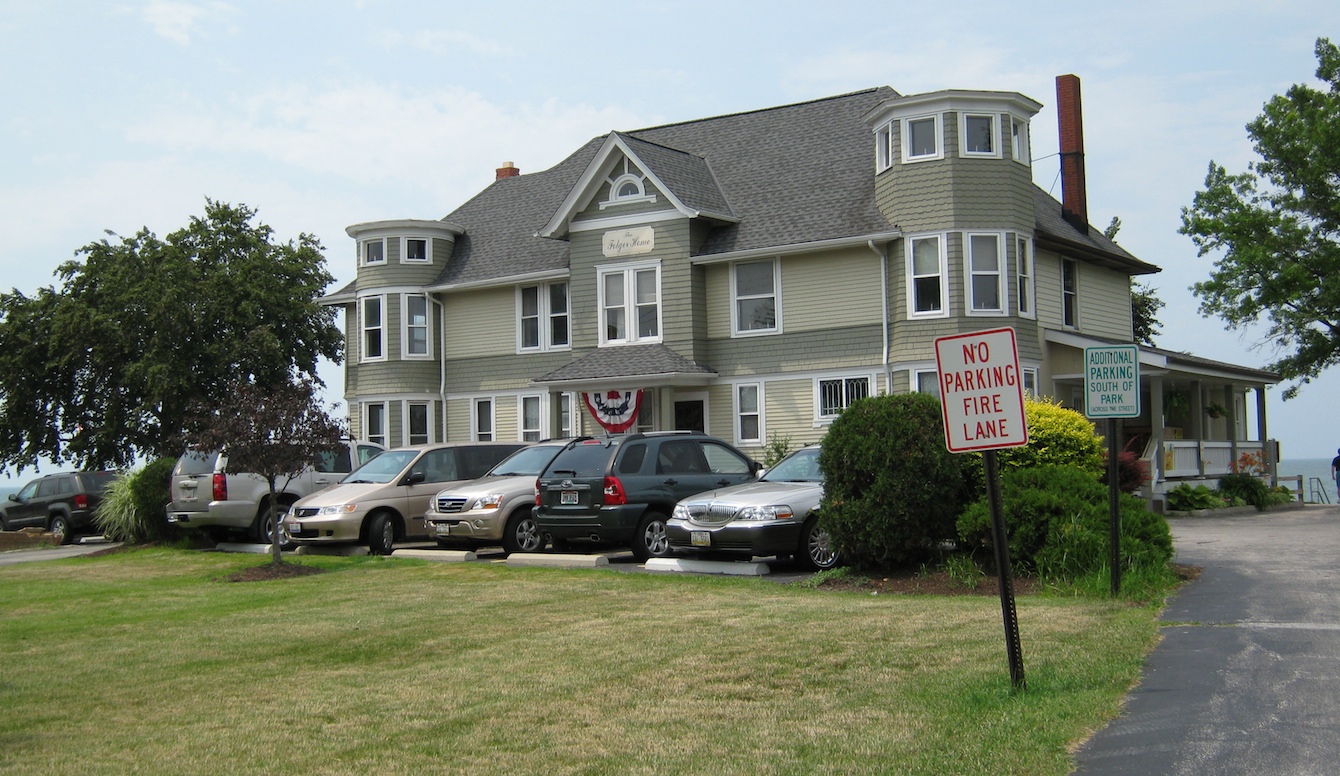
Thomas Folger House in Avon Lake

Ever wonder about the story behind that big house on the lake at the end of Route 83 in Avon Lake? Well, wonder no more. Here's the story, a great article from the Wednesday, April 19, 1967 Lorain Journal, written by Staff Writer Sandy Rider. (The photo and caption from the article are above.)

****

The 'Heart' of Avon Lake is Big Old White Building
By SANDY RIDER
Staff Writer

AVON LAKE – The womb of Avon Lake is in that big old white building they call the Avon Lake Park Hall.

There Avon Lake was nursed, rehearsed and born. Early settlers, government and a court of law were nourished inside its walls.

THE TIME – way back when it gets too foggy to remember details anymore.

FARMERS WITH purple stained hands and tired backs traveled dusty roads to get to Thomas Folger's big white house on the lake. Folger collected, weighed and boxed the grapes for the long trip by Nickel Plate rails.

Sometimes a starry-eyed couple came to the large white house to be married by Folger, justice of the peace.

Folger's children ran through the long halls with high ceilings and played hide and seek.

THE TIME – 1926 when the old duffers can remember –
The leaders of the village were trying to set up a government. They met in the room downstairs in the large white building they bought for $56,000. There they rolled up their sleeves and carved out a government.

W. R. Hinz of 31692 Lake Road, had quite a job as clerk, he remembers. "I had a devil of a time paying all the bills the former clerk had thrown in the wastebasket," he said.

The park hall was remodeled. Walls were knocked out and bedrooms were converted into offices.

It was a real tooth and nail government then.

THE TIME – 1950's
The thriving government outgrew the big, white frame building. It moved into a spanking new brick one on Avon-Belden Road in 1955 or 1956.

In its place came the court. Avon Lake had grown too sophisticated to rely on a rural justice of the peace. The days of meeting in a resident's home over a cup of coffee to haggle over lawsuits were gone.

THE TIME – THE 1960's
Now the almost 13,000 residents of Avon Lake come to the large, white frame building on the lake to the municipal courtroom. Now lawyers and judges define the fine points of law in the room downstairs. And the clerk keeps piles of records in cubbyholes upstairs.

There are some who would like to tear down the large white building and move the court to the city hall on Avon-Belden Road. They say it is too crowded. They say the 12-man jury is forced to sit with their knees almost on their chins during court and there aren't enough offices upstairs for all the officials.

But the people that have known the building want to keep it that way.

Avon Lake attorney Gerald Smith says "There may not be enough room for court, but I hate to see it torn down."

JUDGE ROBERT Hensen, "It's in much better shape than when we first came in. We used to wonder if we'd come back the next day and find ashes."

People around Avon Lake have gotten used to the large, white building on the lake. They may not even know its official name but they would miss it if it was gone.

It has become more than a pile of lumber nailed together. It is the womb of Avon Lake.

****

Here's my shot of how it looked a few weeks ago.

Friday, August 12, 2011

Cedar Point Then and Now Part 2


I've mentioned in this blog before how my family used to hang out over by the games area right before we left Cedar Point, to maybe ride the Space Spiral for a night view, or get some cotton candy to eat on the way to the car. That twilight image on the postcard above really takes me back to the good old days of going to Cedar Point with my family. It evokes the feeling of a boardwalk by an old-fashioned amusement park, such as Coney Island or Palisades Park.

During my day at Cedar Point last Sunday, however, I was pooped by 6:30 and hankering to leave – so there was to be no lingering by the Fascination building after dark. In fact, the building is quite different now anyways (below).

I hate the fact that Cedar Point looks so cluttered now throughout the park, with too many rides crammed into tight spaces. A lot (if not most) of the old-time park atmosphere is lost forever, sacrificed in the name of entertainment.

Thursday, August 11, 2011

Cedar Point Then and Now Part 1

Last weekend, I paid a visit to Cedar Point for the first time in probably ten years. My wife's company picnic was held there, and it provided a good excuse (especially the cheap tickets and free eats) to go back and see how the park was doing.

My wife and I kept at least one of the Brady family traditions alive: taking the unmarked 'back way' in to the park, past Weeping Willow trees and all of those expensive homes. (The last time we went, we came in on US 250, to my regret.)

The 'back way' seemed pretty long to me, just like when I was a kid, when my siblings and I were chomping at the bit to get to the Point. But eventually, the Space Spiral loomed into view (at right), and it was just like old times.

Of course, the Cedar Point of my youth is long gone, replaced by one with spectacular thrill rides that appeal to today's kids. The rides that once were very big twenty years ago seem to be largely ignored by much of the guests today, and I found that the lines were short for old favorites such as the Iron Dragon, the Corkscrew, and the Mine Ride.


Unfortunately, one of my favorites and the only ride I wanted to make sure I got on – the Space Spiral – was closed since it rained (another of our Cedar Point family traditions). Oh well.

I did manage to get a couple of 'then and now' shots, though. Here's a vintage postcard of the Pagoda Gift Shop.

And here's my 'now' shot.

Frankly, I was surprised to see that it was still there – with the same name. (I thought for sure it'd be called X-TREME T-SHIRTS or something!)

Wednesday, August 10, 2011

The 103rd O.V.I. Then and Now

On April 3, 1967 this photo and caption appeared in the Lorain Journal. One of the oldest buildings on the 103rd O.V.I. grounds in Sheffield Lake was slated to be torn down, and was being used for training firemen.

I found a vintage reunion photo of the same building during my latest visit to the 103rd O.V.I. Civil War Museum in May (below).

And here is another view of the same building from a 1924 newspaper article that is also in the Museum.

And here is a long shot of the grounds now. The long-gone building was slightly to the east of the end of the driveway.
By the way, the Civil War Museum is open during the Pancake Breakfasts. Proceeds from the breakfasts help support the Museum, which is really pretty impressive and close to home to boot.

The next Pancake Breakfast is Sunday, September 18... don't miss it!

Tuesday, August 9, 2011

103rd O.V.I. Encampment


A bit of local Civil War history has come to life once again.

It's Camp Week at the 103d Ohio Volunteer Infantry in Sheffield Lake. It's a tradition going back to 1866, when the men of the 103rd decided to hold an annual summer reunion to renew their friendships.

Early reunions were one and two-day affairs with only the veterans present. The location varied from year to year, with the most popular spot being Randall's Grove in Lorain, near the site of the present Overlook Apartments on East Erie Avenue (US 6).

Eventually the wives and families of the men were invited, and the reunions evolved into weeklong camps.

As the Civil War veterans began to pass away, the surviving soldiers realized they needed to plan for the future. Thus an organization known as the Sons and Daughters of the 103rd was formed in the late 1800's to take over the responsibilities for the reunion.

Four acres of lakefront property was purchased in Sheffield Lake in 1907 for a permanent reunion site, with the first reunion at that location held in 1908. At first, the grounds were a military-style camp with tents. But to make the families more comfortable, permanent structures were added in subsequent years. These included barracks, a mess hall, a dance hall, and cottages.

It is this handsome group of white buildings that are still visible from US 6. Descendants of the 103rd O.V.I. live in the cottages year-round.

****

Although Camp Week doesn't usually get a lot of coverage in the media, back in 1933, the encampment still made it into the newspaper headlines. The coverage for the 1933 event is below. (Click on it so you can read it.)

There's also some other things of interest on the page, such as the price of a haircut in Lorain going up and a visit by the Mighty Sheesley Midway carnival.