Wednesday, May 4, 2022

Crystal Beach Roller Coaster Article – May 1951

Proper maintenance of amusement park rides has long been a safety concern. Just as Cedar Point in Sandusky makes it a priority today, Crystal Beach in Vermilion did more than seventy years ago.

The article below, which appeared in the Lorain Journal back on May 5, 1951 provides a nice glimpse of the work involved in removing rust from the roller coaster at Crystal Beach.

****

Rust Removing Crew Works To Ready Big Vermilion Coaster

Tour Hard Work On First Trip

By ROBERT TATE

Ever wonder – as you took your stomach on a two-minute tear on a roller coaster – how it would be to get out and walk and push the one - ton car up one of those deep tips?

Three men were doing that yesterday afternoon at Crystal Beach Amusement park, Vermilion.

RUST BATTLES RUST ON GIANT COASTER

Every year about this time, Rust battles rust on the big coaster, 11 miles west of Lorain.

It's Henry Rust, the man in charge of the dipsy doodle speedway in the sky, who attacks the red rust on the strip metal tracks.

Because of the rust, the six-passenger coaster cars can rarely get around the nearly half-mile circuit on the first attempt each spring.

To get everything ready for the first night of thrills tomorrow, Rust enlisted Paul Ries, Vermilion, shooting gallery operator, and James Ryan, Crystal Beach's manager, to help.

Equipped with oil cans, the trio rode a single car up the first incline. At the top, the cable released the car for what is normally a gravity-powered dash up, down and around to the starting point.

But with rust dragging at the under wheels and side wheels which prevent sway by pressing against side boards, the car slowed to a stop half-way up two dips. Each time safety locks caught the car and the Big Push was on.

Over the top, the men dived back aboard like sailors scrambling into a lifeboat.

To keep up speed on the easy slopes, they pushed with one leg like kids on a giant scooter. Three times the journey was made before the oiling and rust-wearing was done.

Ryan, who lives at 1202 Hawthorne-av, and is safety director of Lorain, said the highest point is 60 feet.

"In the dips, they reach a speed of 70 m.p.h.," he said. That's considerably faster than Ryan's policemen will permit motorists to drive on city streets.

"There is absolutely no danger as long as everyone sits down and keeps his safety belt strapped," Ryan went on. He said the only bad accident in 26 years came when a boy stood up.

The coaster gets faster as the season progresses. Tomorrow night the ride will take two and a half minutes, elapsed time. Later on it will require just one minute, 55 seconds. Both times include one minute towing to get to the top.

After the season closes in the fall, and until winter sets in, Rust inspects and repairs the man-made forest of timbers. He and his family live inside the roller coaster jungle in a small house.

"We use only Alabama long leaf pine with very few knots," commented Ryan. "Wood that we remove is used elsewhere around the park. It's still good."

As far as the skimpy coat of paint on the structure, he explained that, altho customers have more confidence in pretty, heavily-painted framework, insurance inspectors frown on it. They don't want possible defects covered up.

Tuesday, May 3, 2022

Cedar Point Space Spiral Ad – May 1965

When Cedar Point opened for its 1965 season, in many ways it must have seemed like an all-new park to parkgoers who hadn't been there for a while.

New attractions that year included the San Francisco Earthquake ride, Turnpike Cars, Jungle Larry's Safari Island and the Space Spiral.

Here's the article from the August 1, 1964 Journal announcing the construction of the Space Spiral (here called the Space Tower) for the 1965 season.

The ad at the top of this post, touting $2,200,000 in improvements at the park, ran in the Lorain Journal on May 17, 1965. It also mentions the Cedar Point Playhouse and 'Fascinating Building," which I suspect is the one housing the Fascination game.

****

Visit this website to read an article about some of the rides (including all of the ones mentioned above as new in 1965) that are no longer at Cedar Point.

And don't forget to visit some of my old posts about Cedar Point. (There's thirty of them!)

Monday, May 2, 2022

Watching for Rum Runners on Lake Erie – May 1920

Rum-running – the illegal smuggling of alcohol beverages ashore or across a border – is one of the colorful legacies of the cities located on the south shore of Lake Erie, such as Lorain and Avon Lake. Here's an interesting newspaper account of it that appeared in the Lorain Times-Herald of May 25, 1920 on its front page.

****

POLICE WATCH RUM RUNNERS ON LAKE ERIE

Search Canadian Steamer When Reports of Smuggled Whiskey Are Received

Reports of rum runners operating from Canadian shores to Lorain harbor have kept police and U. S. custom officers busy here since Sunday, it was learned today.

Police received a tip Sunday that the Key Bell, Canadian steamer, booked here for coal, landed in port with a cargo of whiskey alleged to have been smuggled from Canada for distribution here.

Lieut. Pat Ryan and Officer Kist were detailed to the case after U. S. Customs Officer Harry Groene had been notified.

Board Vessel

Groene, Lieut. Ryan and Kist made a thorough search of the steamer. They were unable to find any liquor outside of the allowance which captains of Canadian steamers are permitted to carry, police said.

The "tip" received at police headquarters said that the boat had arrived with its cargo of whiskey which was being hauled in trucks from the docks to distribution centers in three or four different sections of the city.

Following the search of the boat, which revealed nothing, the officers visited several places in the city where it was reported the whisky had been taken.

A search of these houses revealed nothing more, officers said.

Police today said the nearest they could come to the solution was evidence which told of one of the sailors carrying a suitcase full of liquor ashore from the boat, unknown to the ship's officers.

This, police believed, was being boot-legged through the city.

Groene Discredits

"If any liquor has been smuggled into Lorain, it has not come in over the boats," said Customs Officer Groene today. "Deputy officers and myself have kept a close watch night and day on all incoming vessels."

"There'll be no whiskey smuggled in here via the lake route," added Groene. "If it comes in at all it will be by the overland route over which we have no jurisdiction."

Police discredited the rumor circulated today that whiskey was being shipped into the city and hauled through the main thoroughfares by the truck load.

****

Elsewhere on that same front page are several items of interest, including a raid on the farm of Frank Lachmeyer, Stop 112 L. S. E. which resulted in the confiscation of a still and "a quantity of raisin jack whisky" by the Sheriff and the Lorain Police Department; a proposal to build a clubhouse of the Lorain Powerboat Club on the lakefront east of Black River; the demolition of a fortune teller's tent by young boys; the inability of the city of Lorain to pay city employees, causing many of then to quit their jobs and seek new positions; the passing of 95-year-old Thomas O'Brien, originally from County Cork, Ireland, who had been a resident of the city for more than 50 years; and an update on shooting victim Stanley Jacoboski (whose sad tale was included in local author Don Hilton's book Murders, Mysteries and History of Lorain County, Ohio 1824 - 1956.

Friday, April 29, 2022

Detroit Edison Docks at Lorain – April 1972

Back in the 60s and 70s, the Journal used to regularly feature wonderful photos of the Great Lakes freighters that used to dock at Lorain, especially the first ones to arrive in the spring. It was part of what made life in Lorain interesting and unique.

Above is one of those photos, with this one by Journal Photographer Jim Fiedler. The caption reads, "The Detroit Edison tied up to the coal dock in the port of Lorain Tuesday to become the third ship of the spring season to enter the port. Two others steamed in last weekend. The ship was loaded with 20,327 tons of coal and left at about midnight Tuesday. It is returning to Detroit."

As always, it's fun to learn about the ship in these photos. 

Two websites, greatlakesvesselhistory.com and great lakes.bgsu.edu provide a nice capsule history of the Detroit Edison. The Great Lakes bulk freighter was built by Manitowoc Shipbuilding Company in 1954 and was launched on September 9, 1954. Its maiden voyage was on April 15, 1955. Its owner was American Steamship Company.

The Detroit Edison was 589.58 feet in length, originally with coal-fired boilers. It was lengthened in 1966 at Superior, Wisconsin by Fraser Shipyards. 

On May, 1, 1970 it was grounded in Amherstburg Channel, Detroit River and sustained slight bottom damage. It ran aground at Fairport, Ohio on September 4, 1970, "when bow thrusters proved useless against strong winds." It ran aground again, on Grays Reef in Lake Michigan, on December 22, 1980.

Finally, in late 1986 it sold for scrap to Corostel Trading, was towed to Brownsville, Texas for breaking up.

According to a more detailed history found here on greatlakesships.wordpress.com, "the Detroit Edison had her boilers automated and converted to oil-firing in 1971 by the American Shipbuilding Company at their Lorain, Ohio, yard."

Detroit Edison, 1973
(Photo by Roger LeLievre and courtesy of greatlakesships.wordpress.com)

Thursday, April 28, 2022

Collins Waits for its New Post Office – April 1972

Fifty years ago, back when the Journal had news bureaus in many cities in and around the so-called "Golden Crescent," the newspaper featured many articles about small town life. What's great about this is that there was a lot of change taking place in these little burgs, and the paper was there to document it.

Along those lines, here's a story about Collins, a small town community located just off U. S. 20 between Wakeman and Norwalk. The focus of the story from the April 6, 1972 Journal is the construction of Collins' new post office, and the mystery surrounding the interruption of its construction.

So did Collins ever get its new U. S. Post Office?

Well, it's on the map. 
Unfortunately, I'm unable to drag the little Google Maps 'Street View" guy kicking and screaming onto North Railroad Street so we can get a nice view of the building. I guess Google didn't want to photograph that street.
At least we can get a glimpse of the brick Post Office (with its flagpole in front of it) from County Highway 58.


Wednesday, April 27, 2022

Royal Canadian Mounties Article – April 1972

To Americans, the Royal Canadian Mounted Police are often seen as stuffy, comical buffoons and something to laugh at, thanks to the Dudley Do-Right cartoons that were part of the old Bullwinkle TV show.

But although the Mounties seem like they belong in the pioneering days of the past, the RCMP still play a role in modern Canada, providing provincial policing in eight provinces, as well as local policing in some territories.

And here's a great article about the RCMP from the April 7, 1972 edition of the Lorain Journal, providing an interesting perspective on the eve of the organization's 100th birthday celebration in 1973. 

Of particular interest are the requirements to be eligible for the force, including being between the age of 19 and 29; being a native of a British Commonwealth country; a minimum height of five feet, eight inches; being single and agreeing not to marry for at least two years; requirements to become an expert in boxing and judo; and being able to handle a canoe (the only requirement that seems uniquely Canadian).

****

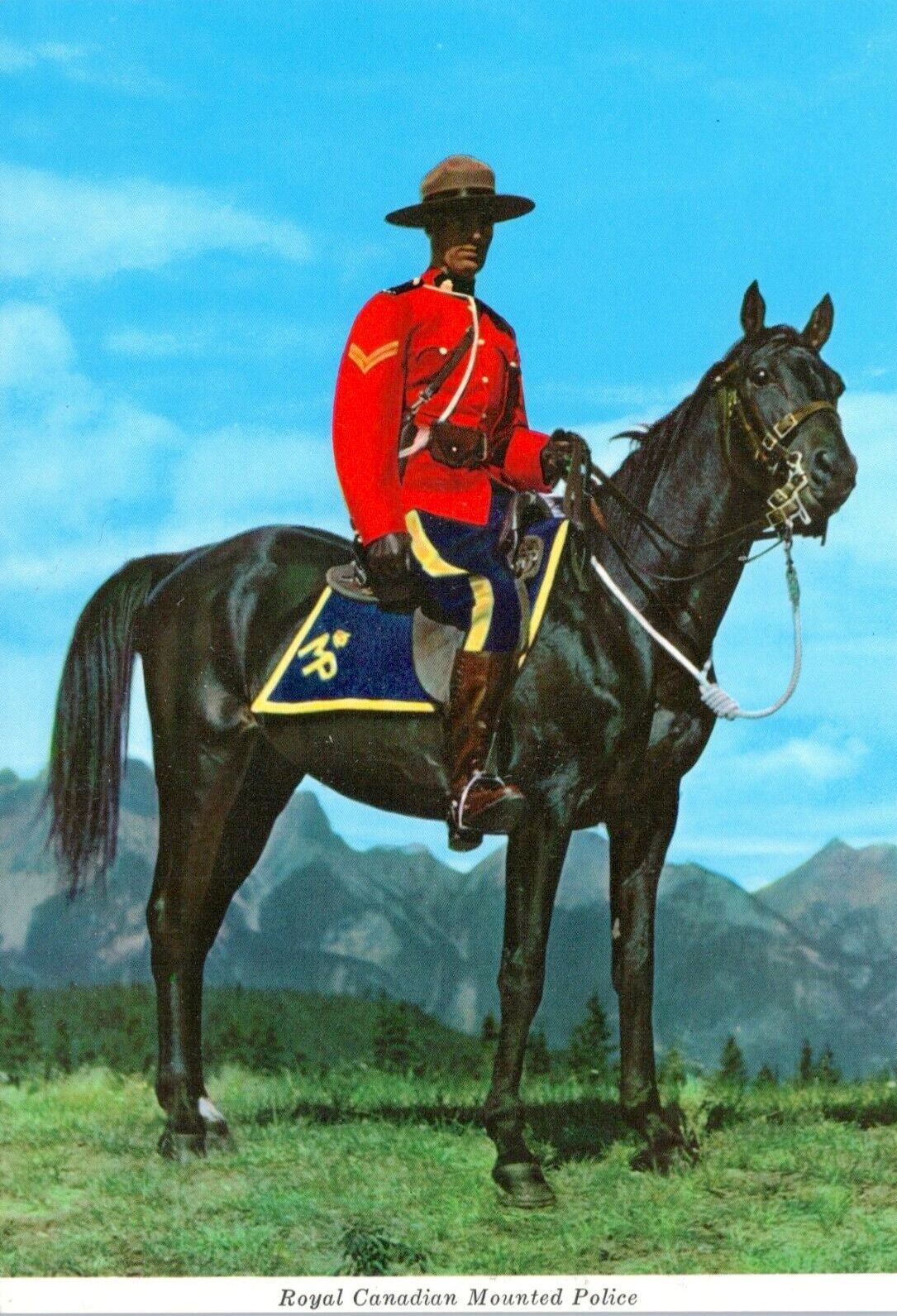
Royal Canadian Mounties – a traditional symbol of Canada, along with the beaver and the Maple Leaf – have long been a favorite subject of postcards. Here are a few, culled from eBay.

****
Canada has been a favorite topic on this blog, eh? There have been many posts on Niagara Falls (one of which featured Dudley Do-Right) and one on Canada's favorite honey: Billy Bee. And don't forget those Canadian bicyclists who visited Vermilion. Or the Toronto Maple Leafs
****
While preparing this post, I remembered something that I hadn't thought about in years.
In the bedroom that I shared with my two brothers when we were kids, we each had a 10" plastic statue of a Canadian Mountie that sat on the headboards of our beds. The statues were souvenirs of our trip to Expo 67 at Montreal.
They looked exactly like this one (below).

Tuesday, April 26, 2022

Cowboy Globe Trotters – 1912 Postcard

You never know what you're going to find on eBay. Take this item for example, which was for sale a few weeks ago.

It's a great vintage "real photo" postcard depicting three gentlemen dressed as cowboys and posing for a photographer in a studio. But it wasn't taken Out West; the photo was shot right here in Lorain, Ohio.

The inscription on the front of the postcard reads, "Cow-boy globe trotter's," with the Lorain photographer identified as "Brittson," with whom I was not familiar. But the back of the postcard (postmarked December 31, 1912) revealed that it was manufactured by the Leiter Post Card Co., Lorain, Ohio.

So I turned to Paula Short, a Leiter expert and collector, as well as one of the authors of the book Lorain: The Real Postcards of Willis Leiter for help in finding out about the photographer. 

Of course, Paula had seen the postcard on eBay. "The Brittson card is a nice one and definitely caught the attention of the Leiter Group," she noted.

"I looked in the 1909 Lorain City Directory and found that Batie T. Brittson was a photographer at 424 Broadway. He and his wife, Orpha, resided at the same address. Leiter Studio was then located across the street at 523 Broadway. This was shortly before the street names and numbers changed later in the same year. He is not listed in the 1912 Lorain City Directory. 

So why was the postcard produced by a competitor?

"Maybe Brittson didn't have the technology to print a RPPC so he took it to Willis?" pondered Paula. "They could have been acquainted - same profession, only a block apart. 

"More research found that Beatty (Batie) was born in Indiana, had first married Grace Weers and later married Orpha Litzenberg. He died in an accident at Youngstown in 1915 and is buried in Maple Grove Cemetery in Findlay, Ohio."

It just goes to show you that when you need help with research, go right to an expert. Thanks, Paula!

But what about the three amigos dressed as cowboys? 

I'm afraid I can't find out anything online about these urban cowpokes. The fancy duds (and lack of guns) make me think that these dudes were entertainers, perhaps musicians. 

Or maybe it was just three buddies having fun and posing for a novelty photo – like the kind you can get at Cedar Point or some other tourist mecca.