Wednesday, November 3, 2010
Next up: Skyline Drive Memories
Back here, I wrote about what it was like to attend Charleston Elementary School in Lorain during the early 1960's.
But shortly after I started first grade, my parents moved the family from the 1950's ranch they built on W. 30th Street to a brand new house on Skyline Drive, a few streets away to the south.
The new house was only a few minutes from our old house on W. 30th Street, but it might as well have been a hundred miles away. Because not only was our house in a different school district, it was in a unique part of Lorain that was right in the middle of transitioning from farmland to neighborhoods. Which made it a whole new world of fun and wonder for kids that were used to monotonous, numbered streets laid out at perfect right angles to each other.
So please stop by here next time for Part 1 of my look back at 1960's Memories of Skyline Drive. I think you'll find that many of the memories discussed are your Lorain memories too.
Tuesday, November 2, 2010
1958 Lorain School Levy Ad
From the 'some things never change department'!
Just as it is right now, Lorain was trying to pass a school levy back in the fall of 1958. Here's a newspaper ad that ran in the Lorain Journal back in late October of that year. (Click on it for a closer look.)
Advertising approaches certainly have changed over the years. The ad grabbed my attention because of its use of illustration. I love the bold silhouette graphic used to represent teachers (although it seems to imply that teachers were all women back then.)
I'm not sure why the desk is lurching to one side. Maybe the ad has a subliminal 'sinking ship' message?
What's hilarious (to me at least) are the clip art illustrations used to represent the children. The freckle-faced little boy is wearing a Jughead-style 'crown' hat. Here's what a wiki entry for Archie's pal Jughead says about the hat:
This type of crown-shaped cap often puzzles modern readers, but caps like this were popular among boys in the 1930s and 1940s. It was made from a man's felt fedora hat with the brim trimmed in a zig-zag and turned up. In the 1920s and 1930s, such caps usually indicated the wearer was a mechanic.
All I know is that the boy looks like a bully or junior thug! And the little girl's face is filled with apprehension – maybe at the thought of the levy failing.
I didn't load the next microfilm reel to find out if the school levy passed back then, as I ran out of time. I wonder if it will pass this year? We'll know soon.
Just as it is right now, Lorain was trying to pass a school levy back in the fall of 1958. Here's a newspaper ad that ran in the Lorain Journal back in late October of that year. (Click on it for a closer look.)
Advertising approaches certainly have changed over the years. The ad grabbed my attention because of its use of illustration. I love the bold silhouette graphic used to represent teachers (although it seems to imply that teachers were all women back then.)
I'm not sure why the desk is lurching to one side. Maybe the ad has a subliminal 'sinking ship' message?
What's hilarious (to me at least) are the clip art illustrations used to represent the children. The freckle-faced little boy is wearing a Jughead-style 'crown' hat. Here's what a wiki entry for Archie's pal Jughead says about the hat:
This type of crown-shaped cap often puzzles modern readers, but caps like this were popular among boys in the 1930s and 1940s. It was made from a man's felt fedora hat with the brim trimmed in a zig-zag and turned up. In the 1920s and 1930s, such caps usually indicated the wearer was a mechanic.
All I know is that the boy looks like a bully or junior thug! And the little girl's face is filled with apprehension – maybe at the thought of the levy failing.
I didn't load the next microfilm reel to find out if the school levy passed back then, as I ran out of time. I wonder if it will pass this year? We'll know soon.
Monday, November 1, 2010
1958 T.N. Molas Furniture Store Ad
In honor of Tuesday's election, here's part of an ad that T.N. Molas Furniture Store ran in the Lorain Journal in late October 1958, right before the election that year. (Click on it for a closer look.)
I thought its donkey and elephant political theme was kind of cute and clever. (I can't help but think of Eddie Murphy's Shrek character when I look at that donkey, though!)
According to a Lorain history compiled by the Lorain Public Library, T.N. Molas Furniture Store opened for business in 1934.
I thought its donkey and elephant political theme was kind of cute and clever. (I can't help but think of Eddie Murphy's Shrek character when I look at that donkey, though!)
According to a Lorain history compiled by the Lorain Public Library, T.N. Molas Furniture Store opened for business in 1934.
Ohio Edison Demolition Update
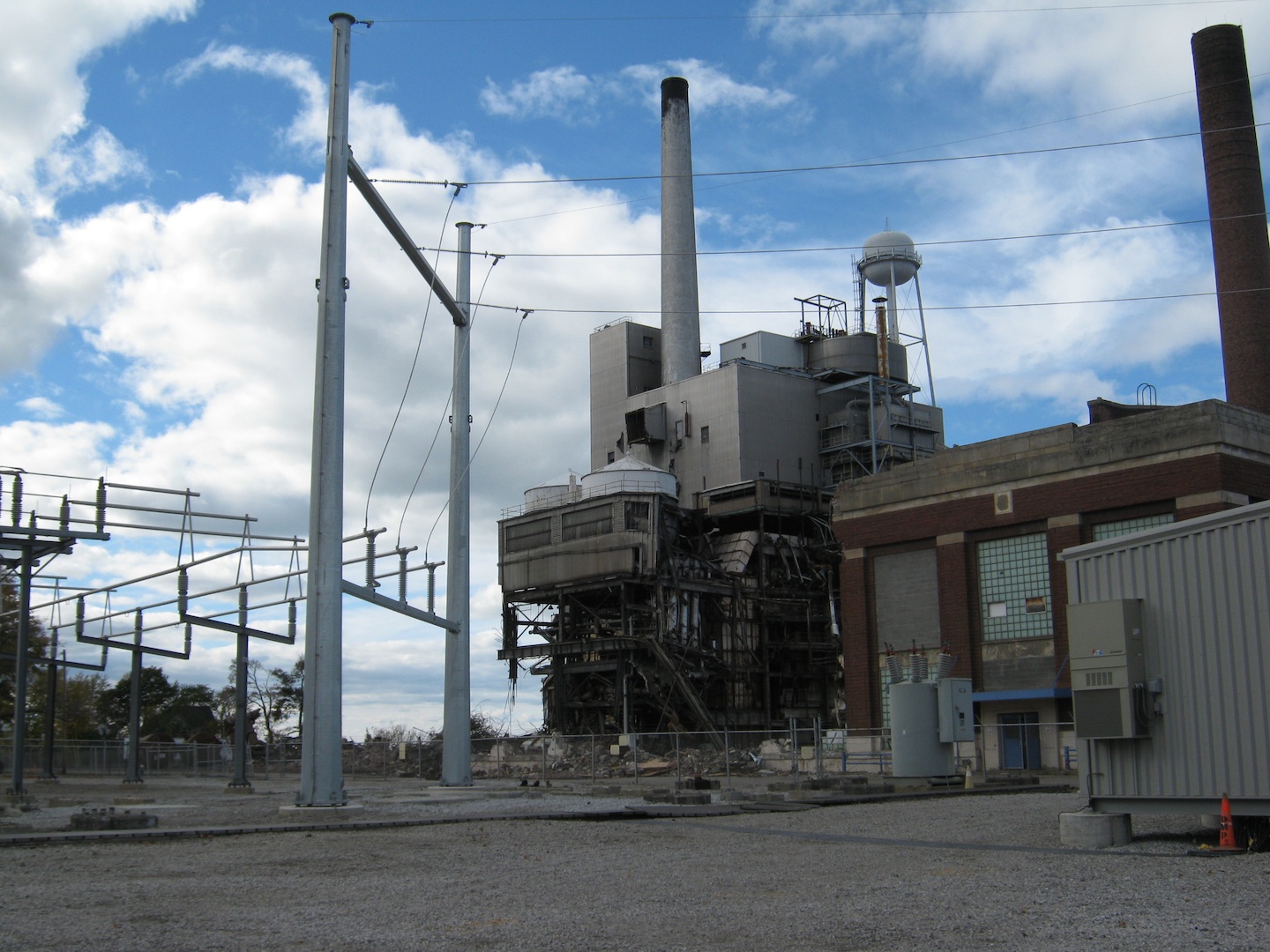
I was away for the weekend, but managed to swing by the old Ohio Edison plant this afternoon to see how the demolition was coming along. The lake view is really opening up for the residents on W. 2nd Street!
It's still sad to see the facility being gutted, though. It's really kind of a work of art, the way the smokestacks, water tower and parts of the building all reach for the sky in an almost organic fashion.
It took a while, but I finally found an appropriate demolition reaction shot of our pal Reddy Kilowatt!
I'm curious to see how the tallest portions of the plant will come down. Hopefully the Morning Journal or Chronicle-Telegram will post some video of it when the time comes.
Friday, October 29, 2010
Halloween 1961
Here's what my older siblings and I looked like for Halloween 1961. (Sorry, Ed – you were only seven months old and too young to join this rogue's gallery!)
It's interesting to me mainly because of my older brother's costume (certainly not because of mine!) Remember back here a few days ago when I mentioned that TV cartoons would soon take over the kid's Halloween costume market in the late 1950's? Here's a good example.
The Flintstones had debuted a year earlier in September 1960 as an adult show, but it didn't take very long for the show to begin influencing children's products.
Thinking back, we must have accumulated more than a dozen of those flimsy plastic masks through the years, including Woody Woodpecker, Huckleberry Hound, Popeye, Bugs Bunny, Casper, etc. Every year a few more new ones came out and were added to the stash.
I still remember the masks cracking easily and rubbing against our face. Sometimes the mask would split where the hole for the rubber band was, so that it wouldn't keep it on your head, and you had to just hold it up with your hand (making it hard to maneuver your trick or treat bag).
The bottom part of the costume always had the character's name, as well as an illustration of them. I always thought that was a little bit strange. Why would Fred Flintstone wear a shirt with his name on it and a picture of him? The bearskin rug that my brother wore was a much better solution (and warmer too.)
Ebay is a great place to find these old masks. I looked a few days ago, and there was the Fred Flintstone mask, looking just like I remembered it.
In later years, we grew out of the plastic cartoon masks. The last time I went trick-or-treating was as a hobo (a costume which in today's economy will probably be making a big comeback). I had the whole burnt cork bit around my mouth not unlike Fred Flintstone's muzzle.
I think I was in junior high, or almost, and my younger brother and I were racing around the Masson School area, trying to squeeze in as many houses as possible.
The reason I remember that night is because at one of the very last houses, the guy that answered the door (I still remember the house) took one look at me and sneered, "Aren't you a little old to be trick-or-treating?"
I was crushed, and that was the end of my trick-or-treating career.
Now, decades later, I've seen kids with real facial stubble trick-or-treating. Oh well.
Happy Halloween!
It's interesting to me mainly because of my older brother's costume (certainly not because of mine!) Remember back here a few days ago when I mentioned that TV cartoons would soon take over the kid's Halloween costume market in the late 1950's? Here's a good example.
The Flintstones had debuted a year earlier in September 1960 as an adult show, but it didn't take very long for the show to begin influencing children's products.
Thinking back, we must have accumulated more than a dozen of those flimsy plastic masks through the years, including Woody Woodpecker, Huckleberry Hound, Popeye, Bugs Bunny, Casper, etc. Every year a few more new ones came out and were added to the stash.
I still remember the masks cracking easily and rubbing against our face. Sometimes the mask would split where the hole for the rubber band was, so that it wouldn't keep it on your head, and you had to just hold it up with your hand (making it hard to maneuver your trick or treat bag).
The bottom part of the costume always had the character's name, as well as an illustration of them. I always thought that was a little bit strange. Why would Fred Flintstone wear a shirt with his name on it and a picture of him? The bearskin rug that my brother wore was a much better solution (and warmer too.)
Ebay is a great place to find these old masks. I looked a few days ago, and there was the Fred Flintstone mask, looking just like I remembered it.
In later years, we grew out of the plastic cartoon masks. The last time I went trick-or-treating was as a hobo (a costume which in today's economy will probably be making a big comeback). I had the whole burnt cork bit around my mouth not unlike Fred Flintstone's muzzle.
I think I was in junior high, or almost, and my younger brother and I were racing around the Masson School area, trying to squeeze in as many houses as possible.
The reason I remember that night is because at one of the very last houses, the guy that answered the door (I still remember the house) took one look at me and sneered, "Aren't you a little old to be trick-or-treating?"
I was crushed, and that was the end of my trick-or-treating career.
Now, decades later, I've seen kids with real facial stubble trick-or-treating. Oh well.
Happy Halloween!
Thursday, October 28, 2010
The Thing at the Foot of the Bed
In honor of Halloween, I'd like to tell you about a great book that I borrowed many times from the Masson Elementary School library in the late 1960's. It's called The Thing at the Foot of the Bed and Other Scary Tales by Maria Leach, first published in 1959.
This book left a huge impression on me, and I recently bought a battered copy of it online. More than forty years after I first read it, it still gives me the creeps. Why?
First of all, it really wasn't a typical children's book. It's filled with gruesome beheadings and horrible murders. Oh, the title story is amusing enough, and there are a few other funny tales. But the rest of the book still makes me uneasy.
Maria Leach is actually a well-known authority on folklore, and she compiled these stories from all over the country, as well as the world. She provides an explanation of the origin for each tale in the back of the book.
The thing that I remember most about the book are the haunting illustrations by Kurt Werth. They are drawn in a loose, sketchy style that perfectly complement the subject matter and greatly enhance the enjoyment of the book.
The book is divided into six sections, categorized by the type of stories: FUNNY ONES, SCARY ONES, REAL ONES, GHOST GAMES, WITCH STORIES, and DO'S and DON'TS ABOUT GHOSTS. (The DO'S and DON'Ts have been burned into my memory since I first read the book!)
So, if you have fond memories of this book as I do, perhaps you'll enjoy a few of the stories. Here's the title story. (Click on each page for a readable version.)
Okay, that was a funny one. Here's one a little more... gruesome.
Here's a story from the REAL ONES section of the book. In the back of the book, Mrs. Leach explains that this tale is a variation of one of the most popular and widespread ghost stories in the United States.
Here's one from the WITCH STORIES section. I always found this particular story (Singing Bone) kind of shocking and poignant.
Lastly, here are a few useful tips that might come in handy this Halloween!
Hope you enjoyed these selections from the book! Happy Halloween – and don't forget to cover your mouth when you yawn!
Tuesday, October 26, 2010
The Ebenezer Gregg/Myron Foote House
Sometimes when I select a topic for this blog, I bite off more than I can chew. Such is the case with today's topic, the Ebenezer Gregg house.
I first saw the above picture in a 1959 souvenir book commemorating the 125th Anniversary of Lorain. Its caption read, "First big house on the East Side was the home of Ebenezer Gregg, who came to Ohio from Dorchester, New Hampshire in 1835. The house still stands at the corner of E. Erie Ave. and Idaho Avenue."
I didn't remember ever seeing this house on E. Erie Avenue, but I realized that sometimes old homes get renovated. So I headed over there anyway with my camera, hoping the house would still be there.
I first saw the above picture in a 1959 souvenir book commemorating the 125th Anniversary of Lorain. Its caption read, "First big house on the East Side was the home of Ebenezer Gregg, who came to Ohio from Dorchester, New Hampshire in 1835. The house still stands at the corner of E. Erie Ave. and Idaho Avenue."
I didn't remember ever seeing this house on E. Erie Avenue, but I realized that sometimes old homes get renovated. So I headed over there anyway with my camera, hoping the house would still be there.
Eastlake Apartments at 960 E. Erie Avenue |
However, the house was apparently gone. A large apartment house stood on the southwest corner of Idaho and E. Erie, and a very old house was on the southeast corner. Where Idaho Avenue crosses on the north side of E. Erie, a closed convenient store was on the west side and another old house was opposite it.
Neither of the two remaining old houses looked much like the illustration, unless extensive renovations had taken place. So I concluded that the Gregg house must have been where the apartment house was now. But I had to be sure.
Using the city directory, I checked all of the residential listings in the area from 1958 on, looking to see if any of them had disappeared before being replaced by either the apartment house or the convenient store. It turns out that before the Convenient Food Mart appeared in 1980, there had been a gas station or auto repair shop at that location dating back to the late 1920's. So the Gregg house definitely wasn't at that location.
I discovered that only one homeowner's address, 954 E. Erie, had disappeared around 1972 – and had been replaced by the Eastlake Apartments at 960 E. Erie in 1974. A gentleman named Myron Foote had lived at the 954 address, sometimes with other tenants, at least since 1919.
I was ready to conclude that the Gregg house had been at that location, but then I ran into trouble.
While checking the earliest city directories, I had found several listings of Greggs – but none of them at the 954 E. Erie Address. There was Mrs. E. Gregg at 93 E. Erie (1891), Arthur and Anna Gregg at 921 E. Erie (1903 & 1905), and Warren A. and Anna Gregg (the same couple?) at 1007 E. Erie (from 1912 to 1920). All on the north side of the street. And the 1007 E. Erie house was on the corner of Idaho and E. Erie!
The house at 1007 E. Erie |
So I did some more research, and found out that according to Early Days in Lorain by William Wickens, Mr. Gregg had opened subdivisions on his farm in anticipation of the railroad coming to town in the 1870's. A book of county maps from the 1960's indicated that the lots that were part of the Gregg subdivision were on the lake side of E. Erie.
So if the Gregg farm was on the lake side, would that include his house as well? Thoroughly confused, I decided that I was going to need some help with this.
And then a happy coincidence occurred.
While visiting Loraine Ritchey's always thought-provoking blog, I happened to notice that someone left a comment on October 18th regarding a "beautiful 'older' home on the corner of Idaho Avenue and East Erie Avenue." The comment mentioned that "it was purchased and torn down to make way for an eyesore apartment building."
I excitedly emailed Loraine, asking her if she had ever heard of the Gregg mansion, and she kindly put out the word on her blog that I was looking for information.
Boy, did she get results – and fast!
The emails started pouring into my inbox, each one with another fantastic attachment.
Dennis Lamont provided an aerial view of the area from the 1920's, which enabled me to positively confirm that the house (with its distinctive roof and chimney) was where the apartments are now located.
Here's the "then (at top) and now" aerial view using Dennis' photo. (Click on it for a closer look.)
But it got even better. Renee Dore did extensive research and found an article with this great photo of the house and Mr. Myron Foote. It's amazing how little the house had changed over the years.
According to the March 2, 1966 newspaper article, Myron Foote and his wife were trying to get a zoning variance for the property so that they could sell it to a prospective buyer. (Foote and his wife were moving into the Kennedy Plaza apartments.) A neighborhood group, however, objected to the property being rezoned for business and circulated petitions.
A few days later, the Building and Lands Committee denied a City Planning Commission recommendation that the property at 954 E. Erie be rezoned from residential to business.
Just when I thought I had seen it all, I heard from Loraine again a few days later. "Did you get the picture with the bulldozer in front?"
I couldn't believe it. I told her that finding that photo was like finding the Holy Grail! Renee had hit the jackpot!
Here it is.
At the time of this photo (May 16, 1969), the zoning change had finally been approved and the apartments were already planned for the site. A committee had been formed to try to save the house, but it was obviously to no avail.
I should also mention that other people also posted comments on Loraine's blog to help me out.
So while it was sad to know for sure that this great old building (and a big part of Lorain's history) fell victim to the wrecking ball more than four decades ago, it was great to find out that there are so many friendly people out there with a love for local history that were willing to help me.
In conclusion, I want to thank Loraine Ritchey, Renee Dore, Dennis Lamont, the reference librarians at the Lorain Public Library, and the volunteers at the Black River Historical Society for their help with the research on this subject. Because of their help, this short history is a lot more complete – and for that I am grateful!
Now, what should I write about next? Something easy, I hope!
Subscribe to:
Posts (Atom)