Monday, February 13, 2017

Wellington Man’s Lincoln Medal – Feb. 12, 1952

From Lorain Journal of Feb. 12, 1952
Well, yesterday was Abraham Lincoln’s Birthday, so it’s a good time for this post. It’s about a Wellington man with a special keepsake: an original medal struck in 1860 to commemorate Abraham Lincoln’s campaign for the Presidency.

You can read all about it in the article below, which ran in the Lorain Journal on February 12, 1952.

****
C.D. Battles Holds Gift of 1860 From His Grandfather
Wellingtonite Proud of Lincoln Campaign Medal

WELLINGTON – Abraham Lincoln, the subject of so many controversies while he was in office as the President of the United States, set such an example for those who followed him that today anything related to him is regarded as virtually priceless.

Among the many material objects concerning Lincoln which today brings a fancy price on the market are the original campaign medals struck in 1860 when the lanky Lincoln was first seeking the highest office in the land.

Just such a medal is owned by Clyde D. Battles of Wellington, whose photographs accompany this article. Battles has one of the very few medals from Lincoln’s initial bid for public office.

He received this prized object from his grandfather, the late Peter Dagnan, who wore the medal on a piece of black ribbon when he was just a child. Other medals of a similar nature were cast in 1864 after Lincoln had proved his leadership but Battles owns one of the original 1860 models.

On the front of the medal is a bust of Lincoln, showing his features,  as being more even and regular than usually pictured in present day art. He seems to have a studious look and his nose is smaller than usually portrayed.

Also on the front are the words, “Hon. Abraham Lincoln” and the date 1860, along with the name of the designer of the medal, a man named Ellis.

On the back side are the words “The Rail Splitter of the West” and a picture of a man with the axe poised, ready to strike at a log, as another man sits and watches. In the background is a log cabin, similar to the one in which Lincoln was born in Kentucky.

The medal owned by Battles is a bronze piece, about one inch in diameter. Through the top is drilled a hole, placed there so Battles’ grandfather could carry it on a piece of tape or string so it wouldn’t be lost. Peter Dagnan proudly wore the medal through Lincoln’s first campaign.

In 1864, when the second issue of medals was struck, every parade backing Lincoln had a wagon full of men engaged in rail splitting, the strong point in Lincoln’s campaign – the fact that he was a common man and knew the common man’s problems.

Battles, who won’t even estimate the value of his Lincoln medal, keeps it with his coin collection, fearful of losing this bit of American history.

Battles’ grandfather, although he wore the medal with pride as a youngster, never got to see the noted President. The closest he ever came to that was when Lincoln’s body passed through Wellington after his assassination.

****
Here’s a photo of the back of one of the 1860 Lincoln campaign medals, courtesy of pinterest.

And here is the link to a blog that is focused entirely on one person’s collection of these types of medals. The blog – “19th Century Presidential Campaign Tokens/Medals” – even has a great photo of an 1860 Lincoln medal (below). The blog also has some information about it, including the identity of the man watching Lincoln split the rail.
Courtesy prestokens.blogspot.com

Friday, February 10, 2017

Old Vermilion Railroad Article – Feb. 13, 1952

The Lorain Journal of the 1950s were full of interesting little historical tidbits. These short articles are important in that some of the information contained in them is not readily available today – so I enjoy transcribing and posting them.

Here’s one of those articles, that appeared in the Lorain Journal on February 13, 1952. It’s a “what might have been” look at the Vermilion and Ashland Railroad.

Blame Reckless Management
Only Scars Remain Of
Old Vermilion Railroad
By PAUL LUDLOW

VERMILION – Only the scars of the Vermilion and Ashland Railroad remain here but the tracks can be traced through the woods today.

Few people here remember the railroad, and no wonder, since it was hardly ever used.

On March 5, 1842 the railroad was granted $44,000 by the Ohio State Legislature and the firm started laying long lengths of track here.

It is said that had the large sums of money received and wasted along the whole line been put to use in completing and putting the cars in motion over a part it would have resulted in success.

Idle Ever Since
As it was, through the reckless management of the firm, it ended in a total loss to the state and to all involved. The tracks have been idle ever since.

About 10 years later, in the years 1851 and ’52, the Lake Shore and Michigan Railway Company put its lines through Vermilion and the first train to travel over the route came through Vermilion in the summer of 1853.

The firm named an engine “Vermilion” in 1872. The railroad was a combination of a number of companies that have since been incorporated into the New York Central System.

One of the first locomotives, called “The Jenny Line,” to be run over the tracks, was brought here across Lake Erie from Buffalo and was drawn from the harbor to the tracks by six teams of oxen.


Thursday, February 9, 2017

Penfield Avenue Bank – Then & Now

Last month, regular contributor Rick Kurish emailed me with a suggestion for a post. He wrote, "As I was looking through Ebay today, I ran across an old postcard of the Penfield Avenue Bank (shown above).

"As you probably know, it was a substantial building on Broadway, across from the old location of St. Joseph Hospital. Although the bank building itself is long gone, the site is easily identified by the four stone columns that supported the front facade. These were left standing on the site when the building was demolished, and for all intents appear to be the remains of ancient Roman ruins. It might make a before and after subject for your blog."

Rick’s suggestion was a good one, because I hadn’t seen this particular hand-tinted postcard before. Surprisingly, I had given the bank the “then and now” treatment back in 2013, but with an illustration (show below), not a photo.
(This was the post on which my older brother hilariously observed that,"Judging from the drawing, I think the original Lorainites must have been about 8 inches tall back then. And their horses too.”)
As it turns out, the original Penfield Avenue Bank bank (which later changed its name to the Central Bank Co.) was a favorite subject of a lot of postcards, including this one photographed by Willis Leiter (below).
Anyway, here again is the May 2013 “now” view (below). (Note the traffic lights, a veritable endangered species in Lorain these days.)

 And here’s my shot from last weekend.

Wednesday, February 8, 2017

Leavitt Road Gets Widened 1964-65 – Part 2

As it turns out, the widening and repaving of the portion of Leavitt Road from W. 21st Street to North Ridge Road took a little bit longer than the estimate of one year. But it made the excitement and anticipation of the highway opening even greater.

At last, on the front page of the December 3, 1965 Journal, the small article below about the upcoming ribbon-cutting ceremony appeared.

The article noted that none other than Governor Jim Rhodes would be attending along with state highway officials. Mayor Mathna of Lorain and Mayor Marvin Davis of Amherst would be the official hosts of the ceremony, and bands from both Admiral King and Amherst High Schools were to entertain.
On December 7, 1965 the small article below appeared on the Journal’s front page.
And on Thursday, December 9, 1965, the front page of the Journal spotlighted the highway ceremony of the previous day. The article was accompanied by a great photo by Norm Bergsma showing Governor Rhodes graciously letting local children do the ribbon-cutting honors. “It’s your road. You snip the ribbon,” he told the children.
And here is the continuation of the story, with a nice photo of the Admiral King Marching Band. Hey, I recognize those band uniforms; we were still wearing them in 1977!


Tuesday, February 7, 2017

Leavitt Road Gets Widened 1964-65 – Part 1

My post about O’Hara’s yesterday mentioned the paving of Leavitt Road in the 1960s, so it’s a good time for this historical material. It’s all about the transformation of Leavitt Road into a four-lane highway.

As we know, the widening eventually led to the whole Massacre Mile concern.

The article below appeared in the Journal on March 9, 1964.

****
Leavitt Rd. Repaving
Due For August Start
Concrete Expected For Road
By FRANK RIOS

Reconstruction to transform Rt. 58 (Leavitt Rd.) into a four-lane highway is expected to start in August, according to Donald H. Timmer, director of the Ashland Division of the State Highway Department.

Timmer said contracts for the project, estimated at $1,908,000, probably will be awarded July 1 at Columbus.

Although the original specifications for Lorain’s section of construction called for asphalt, the entire route will be paved of nine-inch deep reinforced cement concrete.

"Amherst said it wanted concrete right from the beginning,” Timmer said. “The job was going to be all asphalt or all concrete.”

Timmer said Lorain went along with Amherst on the choice of material.

Other sources said Lorain was “pressured” into accepting concrete.

Timmer felt there was no coercion used on Lorain to change the specifications.

Mayor Mathna denied that Lorain was forced to accept concrete. Charles Waryu, a first assistant city engineer, said the choice of material is made by the Federal Bureau of Public Roads and the State Highway Department.

He said the composition of the land has to be considered when deciding whether asphalt or concrete will be used on a road.

According to Waryu, the initial cost of using either material is the same. He added that it is debatable as to which material would cost more to maintain after a highway is completed.

“Lorain is not losing anything by the use of concrete,” Timmer said. “No corners will have to be cut because of it.”

Amherst recently passed an ordinance that all new construction in the city will be of concrete.

In Lorain’s portion of the road, curbs and gutters will be installed south from 611, a distance of 1,302 feet. Mathna said postcards were sent to abutting property owners asking them if they wanted curbs and gutters.

According to the mayor, all owners who answered do not want to pay the cost of installing them on the 1, 302 foot section.

Assessments to all the property owners will be the same, whether or not they have curbs and gutters installed in front of their homes.

Amherst residents voted to have curbs and gutters placed the complete distance of that section, which is .69 of a mile. This extends from Rt. 254 south to North Ridge Rd.

Lorain’s section, 2.36 miles, extends from Rt. 254 south to Rt. 611. The whole route will be 48 feet wide from curb to curb when completed.

For a distance of 500 feet north of Rt. 611, there will be salvage construction to widen the road to 41 feet. Seventy feet north of this, the road will narrow down to 34 feet at the railroad crossing.

Curbs and gutters already have been installed in this total distance of 570 feet. They will be moved to the sides during the widening.

Lorain will have open ditches with paved shoulders where the specifications do not call for curbs and gutters. City Engineer Clark King said the ditches will average two feet in depth, and some of them will be four feet deep.

This city’s section of project will cost about $1,437,000, Timmer said. The Amherst portion is estimated at $471,000.

The Federal Government will pay 50 percent of the cost. Lorain will pay 15 percent of the cost estimated for its section, and Amherst will finance 5 percent of its own section.

The state will make up the difference in cost, which is 35 percent in Lorain and 45 percent in Amherst.

Contracts for the widening will be awarded as one job, Timmer said. He expects the project will be completed one year after work starts.

Tomorrow: Dedication of the new Leavitt Road

Monday, February 6, 2017

O’Hara’s Revisited – Part 2

Vintage O’Hara Business Card from the early days
After my tour of the O’Hara’s property, Ralph O’Hara invited me inside his family home to enjoy a cool drink and examine some cherished mementoes of the family business.

This included an original business card that predated the Leavitt Road location (shown above) as well as some vintage newspaper ad clippings (below).

Here’s a 1963 photo of the Pearl Road Drive-in menu board that includes small promotional signs for the drive-in's suppliers, including O’Hara’s Lakeland Poultry Farm (at the upper left hand corner).
Ralph also had a few vintage shots of the store, including one from when Leavitt Road was under construction.
Another souvenir was a December 1971 copy of the Central Sentinel, the newsletter of the Central Security National Bank of Lorain County. In it was a nice capsule history of O’Hara’s Beverage:

“In 1945, Vance and Grace O’Hara started in business – this was right after Vance was discharged from the service. They raised chickens and turkeys at that time. Vance O’Hara bought the present site, then built a two-car garage where they conducted their sales transactions. At that time, there were no paved roads around the store.

“They later decided there was not much security in chickens and/or turkeys so Vance started a small grocery store. Grace was a bit skeptical about the store at first but he convinced her that this particular location would soon be that he called “the heart of Lorain.”

“After a few years of dealing in groceries, they applied for and received their liquor license at which time they added on another section to the store and at the same time started building their home.

“Grace said, “We had several opportunities to sell the business but held on.”

“Vance passed away in 1965 after a long struggle with cancer. Grace recalls that this was the same year they paved Leavitt Road. After Vance’s death, Grace assumed the double burden of running the store and came to rely heavily on her part-time employees. Her two children, Althea and Ralph, helped her out tremendously and as Grace says, “We did it together.”

“Grace built on another section to the store and followed through with the exact plans her husband has envisioned.

"When asked for advice to pass on to others who might be thinking of going into the grocery business, Grace said, “Be prepared to give a lot of hard work and time. You really must be dedicated and believe in yourself to be a success.”

“Grace O’Hara is very proud of the fact that her daughter, Althea, graduated from Ohio State and is now teaching the second grade at the Garfield school. Her son Ralph shows a great deal of athletic talent, playing offensive center and guard at Edison High School.

“On February 15, 1972, Grace will lease the store to someone else and take a long needed rest.”

****
Ralph and I continued to chat about the timeline of the store. The service kept him away for a while, and afterwards he helped run the business in the 1980s.

He got out of it for a while when the store was sold, but he returned to the business in 2012. Once again, the O’Hara family owned the store and was back in charge of day-to-day operations.

Ralph is not sure what the future holds, but for now he really enjoys running the family business.

The store as it looks today, with new attractive signage recently added
It’s obvious that he and his family are proud that the business – one of Lorain’s oldest – has survived for so long, thanks to hard work and loyal customers that continue to “Hit the Spot” for their beverage needs.

The well-known O’Hara leprechaun sign
Special thanks to Ralph O’Hara for the opportunity to learn more about the history of his business, and my apologies for the long delay in preparing this post!

Friday, February 3, 2017

O’Hara’s Revisited – Part 1


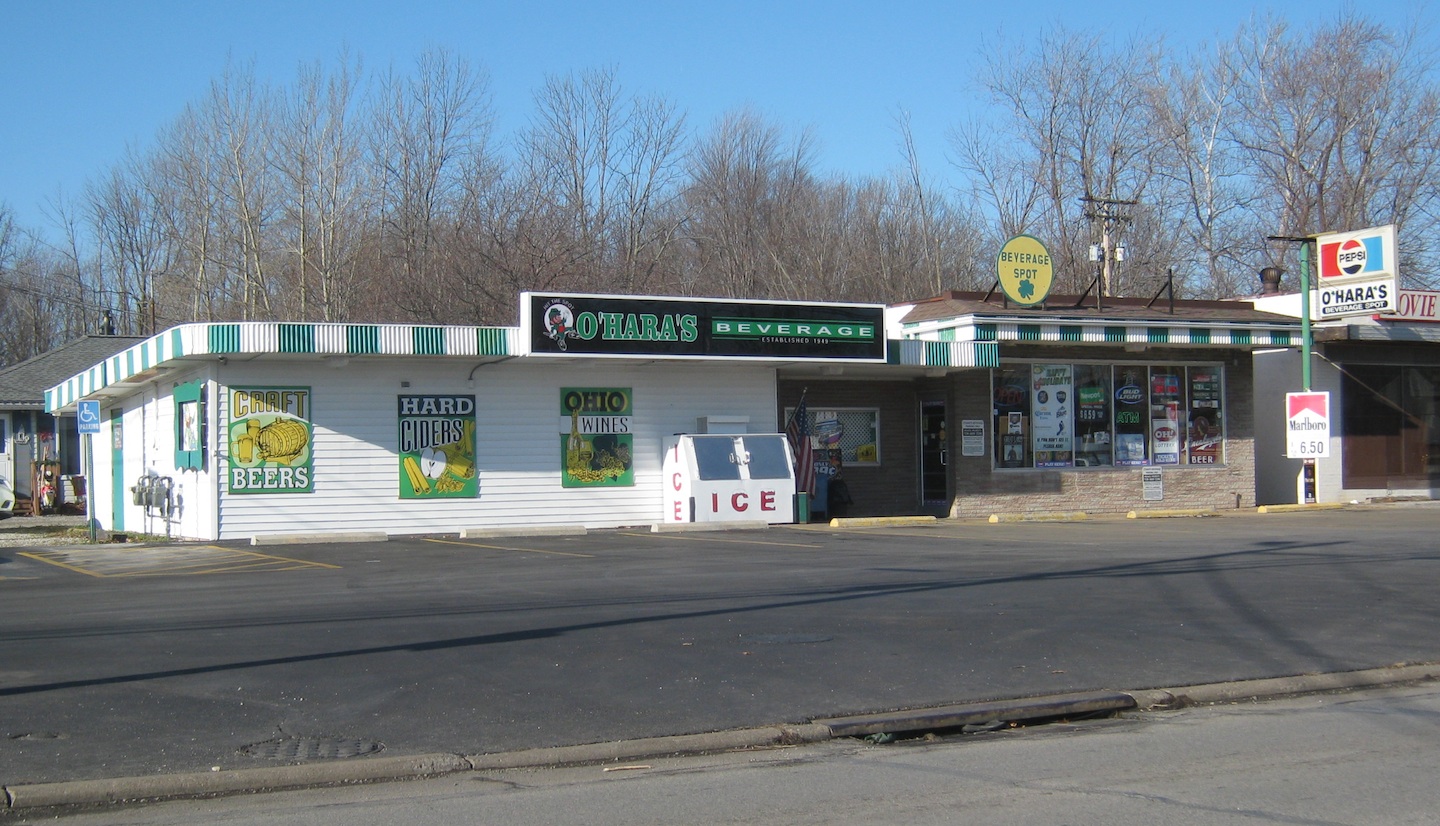
O’Hara’s Beverage Spot as it looked in September 2016
On Wednesday’s post, I mentioned that there wasn’t much out there on Leavitt Road near W. 21st Street back in the late 40s and early 50s. But there was one business run by the O’Hara family that was in its early years, and is still around today.

You know it as the popular O’Hara’s Beverage Spot.

Ralph O'Hara
I had done a post on it back in February 2011 that briefly told how the beverage store business had started out as a poultry farm. But then last summer I received a nice email from Ralph O’Hara.

He wrote, "I want to thank you for the great history of my family business. My wife and I currently operate the business  and it is doing great. 

"I have spent all but ten years of my life on this property.  I am currently sixty-one. There are some other side stories about this property/business. 

"I would be more than happy to  tell you about them if you want to update the story.”

I couldn’t refuse an offer like that. And so – on one of the hottest Saturdays of last summer – I paid a visit to O’Hara’s Beverage Spot, where I enjoyed the hospitality of Ralph O’Hara and his wife, Beverly. 

I met Ralph in the store. Customers were coming and going, with regulars greeting him by name.

The store does a good business selling lottery tickets. “Did you know we’re the number one online retailer of Ohio Lottery tickets?” he asked proudly.
Ralph also pointed out that the store’s customers were not just looking for cold beer. His clientele actually have discriminating tastes in wine and craft beers.

After chatting in the store for a while, it was time for us to tour the grounds and talk about the history of the business. 

Ralph told me how his parents, Vance and Grace O’Hara, started their poultry business after Vance was discharged from the service. They raised chickens and turkeys.

Then they bought the property where the business is today. Vance built a two-car garage where he conducted his sales transactions.

That garage still stands today. Taking me behind the beverage store, Ralph showed me that the white portion of the building was the original garage structure.


We then walked to the rear of the O’Hara property where Ralph pointed out a white building (below) that’s currently used by a church. However, it had a very different function when it was part of the O’Hara poultry business.

“That’s where the chickens were slaughtered,” he explained.

Ralph also told me that at one time the grounds behind the store were known as O’Hara Park. There was a rental hall, and it was used for union picnics.

"Of course, they had to buy their beer from O’Hara’s,” Ralph smiled. 

Next: the rest of the story