Tuesday, April 12, 2016

Sign of the Times

It’s always nice to get suggestions for blog topics from readers. I’ve received several in the last few months, so I’ll feature some this week.
Jeremy Reynolds has a job that requires him to travel a lot in the area. Last December, he contacted me with an observation about something he’d noticed that I might be interested in.

He wrote, “I saw your post about the vintage Route 42 sign. Maybe you can do a post about the vintage street sign at the corner of Hillsdale and West Erie. It’s one of those 1930s era signs, and the only one I know of still standing in Lorain.”

It was a good suggestion, as I’m always interested in examples of vintage roadside archeology that have somehow survived to the present.

I’d noticed that style of ornamental street sign over the years around Lorain (especially the rusty ones) but was not aware that they were becoming rare. Apparently the battered one at Hillsdale and West Erie was one of the last ones, which Jeremy noticed in his travels.

As it turns out, Jeremy’s suggestion was pretty timely.

Just in the last few months, the rusty, vintage sign was replaced by one of the new format signs (rounded edges with a white trim) that are becoming more common throughout that roadside corridor.

Just a tiny transition in the big scheme of things that reminds us that changes in our environment are alway taking place, whether we notice them or not.
Thanks to Jeremy Reynolds for his suggestion.

Monday, April 11, 2016

Our First TV

As promised (here), I went through Mom's photo albums to come up with a nice photo of our first TV, the one we had back in the late 1950s and early 60s. (That's my chubby arm at left; I had to crop myself out of the photo, as I was apparently a budding nudist when the photo was taken.)

The photo is dated November 1960.

I had difficulty coming up with what brand it was. Mom didn't remember, and I wasn't sure what year Mom and Dad bought it. So I Googled all sorts of brands and models, not finding anything that resembled it.

I didn't make any progress until I noticed in some of the vintage advertisements that these types of televisions similar to furniture were sometimes referred to as cabinets. I also noticed that our TV had a little ornamental woodwork at the bottom that was not unlike French Provincial.

Using those two attributes, I finally determined that it was a Philco. It just remained to find the right model in an ad.

I couldn't find a dead match but this one (from an ad in the November 30, 1953 LIFE magazine) was similar (below).

There was also one in a 1954 Philco ad (below) on www.tvhistory.tv website that was pretty close.
After that year the particular style seemed to be phased out as I did not see it in subsequent ads.

Mom confirmed that the TV was a Philco. She picked it out because of its Maple finish and French Provincial-like design.
Anyway, it's fun for me to remember being a kid and watching Yogi Bear, Huckleberry Hound and Rocky & Bullwinkle in glorious black and white on that thing.

Friday, April 8, 2016

Fred Harris and His Red Tops at Ben Hart's – April 5, 1957

Fifty-nine years ago this month on April 5, 1957, Fred Harris and his Red Tops were appearing at Ben Hart's at 651 Broadway in Lorain. (Ben Hart had not yet moved his nightclub out to West Erie Avenue.)

There's very little information online about Fred Harris and his band. Happily, some of the trio's recordings are on YouTube.

Anyway, it's Friday and the weekend is here! So, sit back and enjoy some rock and roll that you would have heard if you were in Ben Hart's that week back in April 1957.


Here's "Flang Dang Do."


Here's "The Bull."


Here's the "Organ Rocker."

Thursday, April 7, 2016

The "Lorain" Oven Heat Regulator

I would be remiss if I wrapped up my brief look at the American Stove Company in Lorain without mentioning the famous Lorain Oven Heat Regulator, which is considered to be the first thermostat for manufactured kitchen ovens. It was invented by Benjamin E. Meacham, of Lorain, Ohio, who was the superintendent of the plant.

He designed his automatic heat control, called the "Lorain," in 1913 and tested it at home in his own kitchen for eighteen months. After the success of this test trial, the factory put it into production and the first range equipped with the device shipped in December 1914.

The American Stove Company adopted the regulator for all six of its divisions in 1919.

Here's the whole story, as summed up in an article that appeared in the June 17, 1922 issue of American Gas Journal.


Here's a shorter version of the story, which appeared in the June 3, 1922 edition of Gas Age.
Meacham eventually received patents for his invention, as well as a series of improvements that he designed.
It didn’t take American Stove Company very long to make the Lorain (or Red Wheel) Regulator the star of its advertising – and consequently promote the city in which it was created.
1919 Magazine Ad
1920s Magazine Ad
1922 Magazine Ad
1926 Magazine Ad
1927 Magazine Ad
1927 Magazine Ad
1928 Magazine Ad
1930 Magazine Ad

Wednesday, April 6, 2016

Stove Works Part 3

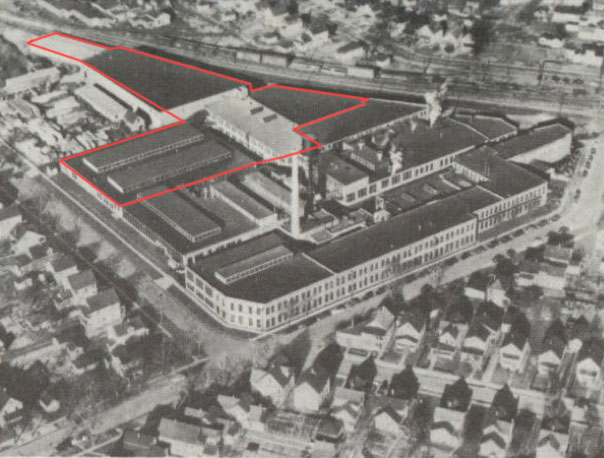
Photo of the Lorain stove works from the 1948
American Stove Annual Report
The 1948 Annual Report of American Stove Works painted an optimistic picture of its Lorain operations.

It notes, “Steel was scarce until late in 1948. It was necessary to use premium steel, obtained at high cost. Toward the end of the year, steel became available through the regular channels. Reduction in the cost of steel made it possible for the Lorain Division to reduce prices early in 1949. This, together with an improved line of space heaters, has put the Lorain factory’s products in an excellent competitive position.”

However, the plant still closed in the mid-1950s.

Today the former stove works is surrounded by a fence and mostly demolished. Once the last building is torn down and the debris hauled away, the City of Lorain will take ownership of the property.

What part of the stove works in that 1948 photo is still standing today?

As recently as 2010, there were still several buildings left (below).

Here are those same buildings in the 1948 photo.
But looking at the 2013 view on the www.historicaerials website, there's just one building left.
Here's my view of it from a few weeks ago.
Soon, it will be gone too.
Thus, demolition will finally bring to a close the story of the stove works, one of Lorain’s once-thriving but often forgotten industrial concerns.
Souvenir bricks from the former stove works
(Note the partially visible Metropolitan imprint on the brick on the right)

Tuesday, April 5, 2016

Stove Works Part 2

Aerial view of the National Stove Works in Lorain
(from the American Stove Company 1948 Annual Report)
For many years, I’ve seen vintage postcards of the stove works and wondered just how the factory was situated on Long Avenue. It wasn’t until I saw the photo above of the Lorain factory from the 1948 Annual Report of the American Stove Company that I understood.

That’s Long Avenue running diagonally upward across the photo, beginning at the lower left hand corner. So that means that the road in front of the long, brick building shown in the vintage postcard below is Long Avenue.

You can see in both the aerial photo and the vintage postcard that at the north end of the building, a portion of it is set back slightly from Long Avenue to allow for a grassy area near the entrance at 12th Street.

Thus we know that the photo on the postcard below was taken from 12th Street looking west.

And here’s today’s “now” view, taken about a week ago.

By George, there’s still a red hydrant in the same spot.

If only that thing could talk.

Speaking of that darling fire hydrant, it was manufactured by the Darling Valve & Manufacturing Company. It has DARLING on the top of its bonnet (to use the proper fire hydrant jargon) and the words “DARLING V & M CO” on its barrel.
The firehydrant.org website has two pages of vintage Darling fire hydrants that serve as a guide to establishing the age of one. The one in front of the former stove works shown above dates back from as early as 1917 (although it is impossible to know exactly how old it is).
Tomorrow: How much of the American Stove Company complex is still standing today?

Monday, April 4, 2016

Stove Works Part 1

Vintage postcard postmarked 1913
The site of the old stove works at 12th and Long in Lorain was in the news in February when it was reported that the City was going to be the new owner of the property after it is cleaned up. (Here’s the link to the story on the Chronicle-Telegram website.)

An earlier version of the postcard, postmarked 1909
Often the stove works is an overlooked part of Lorain’s early industrial history, overshadowed by the steel mill, the shipyard and Thew Shovel.

According to A Standard History of Lorain County Ohio (1916) , “Of the other large industries which have given Lorain so substantial a reputation may be mentioned the National Stove Company, a branch of the American Stove Company, which turns out everything in the line of stoves, ranges, ovens and beaters.

“The National Stove Company was originally the National Vapor Stove and Manufacturing Company, which was incorporated in Cleveland in 1889 and its plant and business transferred to Lorain in 1893. In 1895 a consolidation was effected with the Moon Range Company of Columbus, and subsequently the extended and improved plant was taken over by the National Stove Company, a corporation within the system of the American Stove Company.”

Porcelain Door Cover for a
Quick Meal Stove Range
(Courtesy Ebay)
The American Stove Company had factories in St. Louis (which made the larger sizes of Magic Chef ranges), Cleveland (which produced heavy duty cooking equipment), Harvey, Illinois (which made lower-priced Magic Chef gas ranges), Indianapolis (a foundry which produced castings for the various factories) and Lorain (which manufactured oil-burning Quick Meal cooking stoves and Quick Heat space heaters and furnaces).

(Magic Chef’s original name was the Quick Meal Stove Company.)

Anyway, it’s intriguing to see postcards such as these, showing the Lorain factory in its early years.

Here’s another vintage postcard view (below).

Tomorrow, I’ll provide some aerial views to go along with the above postcards so you understand what view is being shown, as well as a then-and-now view. In another post I’ll also identify just how much of the plant is still standing today (for now).