Friday, March 7, 2014

The Eagles of Brownhelm

The mother eagle and her eaglets in the Great Nest of Brownhelm
Here's my article about the eagles of Brownhelm that appeared in the Spring 2011 edition of The Black Swamp Trader & Firelands Gazette. It appears here courtesy of that publication.

The well-known Great Nest that is mentioned in the article fell to the ground 89 years ago this month.

****

Brownhelm’s Famous Eagles Soared in Popularity in the 1920’s
By Dan Brady
Have you ever heard of the Great Nest of Brownhelm? That’s the name commonly used to refer to a famous American bald eagle nest that was located on Lake Road halfway between Vermilion and Lorain. It was the largest known bird tree nest before it fell in a storm in March 1925. But while the nest has attracted much attention over the years, the story of the beloved eagles that called it home has often been overlooked. Fortunately, newspaper accounts from that era exist, and they provide a fascinating story of the challenges that the eagles faced, as well as a glimpse of just how popular the birds were in the community. Let’s take a look back at those days in the 1920’s, when these symbols of American courage and freedom were flying high in Northeast Ohio’s affections.
Where was the historic nest located? It was 81 feet above the ground in a shellbark hickory, in a wooded area on the south side of Lake Road (U.S. Route 6) in Brownhelm Township. The tree was in the rear of the farm of Mr. and Mrs. Frank Buehring, at what was known at that time as Stop 121 on the old Lake Shore Electric interurban system, just west of Baumhart Road.
It may be hard to believe, but eagles had long called that neighborhood home. By the 1920’s, it was generally accepted that they had lived in those same woods for eighty or ninety years. And the Great Nest of Brownhelm, the fourth in a series of nests during those years, had been begun not later than 1890.
Eagles build their nest as a cumulative structure, with a new nest or layer built upon the old one after each successive nesting season. Gradually, the nest expands in height and width and after many years, can become quite large. Incredibly, the Great Nest had measured 12 feet tall and 8.5 feet wide and was estimated to weigh two tons.
With the eagles and their nest visible from Lake Road, they attracted a lot of attention. But the attention was not only from sightseers and motorists, but also from biologists, nature students and a man who would practically dedicate his life to studying the eagles: Professor Francis H. Herrick of the Western Reserve University biology department.
Prof. Herrick would spend much of the 1920’s observing and documenting the lives of the birds. His research was the first comprehensive study of the American bald eagle, and was published in books, as well as the May 1929 issue of The National Geographic Magazine.  He would also become almost a paternal figure and official spokesman for the birds, as we shall see.
An eaglet looks out from
the Great Nest of Brownhelm
In the winter of 1922, Prof. Herrick initiated his studies by erecting a ten-foot square observation platform in a large elm near the Great Nest. A second platform was added in the spring of 1923. Each platform was reached by a ladder and topped with a khaki-colored tent, from which Prof. Herrick could observe the eagles but not be seen. The eagles didn’t seem to mind the tent, and thus Prof. Herrick was able to study and photograph them and their family from his observatory for hours at a time.
Unfortunately, tragedy struck on November 28, 1924. OAK POINT EAGLE IS SHOT AND KILLED – MAN FINED FOR SLAYING ONE OF COMMUNITY’S PETS reported the Lorain Times-Herald on its front page a day later. The article noted, “Residents of this place are mourning the death of one of the two eagles that has helped to make this locality famous for a number of years.”
John Bovinski, a farmer that was new to the area, had believed that the eagles were after his chickens. He shot down the male in the middle of the woods and clubbed him to death. Bovinski was arrested and fined $25. He was spared heavier punishment because he had a large family.
There was some confusion as to which eagle had been slain. Initial newspaper accounts mistakenly believed that the female had been killed.
On December 1, 1924, the Lorain Journal followed up the killing of the bird with more bad news on its front page. FAMOUS EAGLES’ NEST IS VACANT read the headline. The article stated, “For the second time in more than thirty years, Ohio’s famous American eagles’ nest near Vermilion was vacant yesterday, while somewhere the great pinions of the male bird were carrying him across a wintry sky toward his far-off habitat.”
The same article noted, “Once before many years ago, a mate of the old male was killed. He disappeared for a time, but returned at length with the mate who was slain Friday. Biologists and students hope he is gone on the same mission this time, for he and his two wives for years have been enriching the love of the American eagle among scientists of Ohio.”
Prof. Herrick was also interviewed for the article. “It is likely the male will return with a new mate, as he did years ago,” he stated. “If he does not it will be almost a tragedy.”
Meanwhile, the slain eagle was to be mounted and displayed in the Sandusky High School museum. A fight over the body ensued, in which then Governor Donahey was forced to intervene. Eventually the eagle was given to Western Reserve University, and it was later put on display at the Cleveland Museum of Natural History.
As Prof. Herrick predicted, the female eagle did return in February 1925 with a new partner, after an absence of eleven weeks. It seemed that everything would soon be back to normal in the Great Nest. Unfortunately, that was not to be the case.
On March 10, 1925, high winds and heavy rainfall caused the tree containing the Great Nest to crash to the ground. WIND DESTROYS EAGLES NEST NEAR VERMILION was the headline in the Lorain Times-Herald on March 11. The article noted, “The old eagles nest that stood in a high hickory tree in Brownhelm near Lorain is gone. Last night’s high wind and heavy rainfall sent the tree crashing to the ground and closed the history of the famous American Eagles which have made Lorain county their home for over 50 years.”
HOPES TO PRESERVE EAGLES’ NEST was the title of the article in the Lorain Journal on March 12. It stated, “Dr. Francis H. Herrick, professor of biology at Western Reserve University, will visit Saturday the crushed mass of limbs, grass, feathers and bones, the remains of the one-ton nest of American eagles, east of Vermilion, which was destroyed in Tuesday night’s gale. The nest was the most famous aerie in the middle west and had been the home of 50 generations of young eaglets. When the nest fell to the ground newly laid eggs were destroyed, an examination of the aerie today disclosed. The eagles circled above screaming at the farmers and sightseers.”
Prof. Herrick planned to try and preserve the nest for the Cleveland Museum of Natural History. Of the eagles, he noted, “They still have time to build a new aerie and raise another brood.”
Professor Herrick's observation tower
next to the nest that later fell in May 1926
Once again, Prof. Herrick was right. Amazingly, ten days after the Great Nest went down, the eagles began building a new nest – the fifth in that area – in an oak tree in another part of the same grove. This time, Prof. Herrick built an 80-foot steel observation tower nearby that brought him within 40 feet of the new nest, and he enjoyed a productive year of new observations and studies.
Unfortunately, disaster would strike again. On the evening of May 18, 1926, another storm hit and the new nest crashed to the ground.
EAGLES MAY ABANDON NEST AS 3 ARE KILLED IN STORM was the headline in the Lorain Times-Herald two days later. The paper posed this question: “Will the famous American eagles abandon their aerie, near Vermilion, as a result of their most recent calamity which resulted in the death of three 10-day old eaglets in Tuesday night’s storm?” The article noted that, “Since the tragedy which destroyed their nest and killed their young, the parent pair have circled the skies above their fallen nest." An article in the Lorain Journal noted, “For a second time within a year the famous eagles are homeless and childless.”
According to Prof. Herrick in the National Geographic article, a new nest – the sixth in that neighborhood – eventually appeared in a living ash, just over the eastern town line in Black River Township. Initially, he had assumed that it was the same pair of eagles, but he later doubted that they were the same ones. Nevertheless, Prof. Herrick set up a new tower in January 1928.
This pair of eagles, whether they were the original ones or not, were not immune to tragedy either. In May 1928, other eagles entered the area and attacked the pair in furious battles. Sadly, the male eagle was killed, and the female was forced to raise her eaglets alone.
By the end of March 1929, Prof. Herrick noted that the female had a new mate, and it was at that point that his story in The National Geographic Magazine ended. His tower was taken down in June 1930.
A later newspaper account in the Lorain Journal from June 21, 1955, stated that a succession of eagles continued to build their treetop nests in the wooded area along Lake Road until the late 1930’s. Today, more than seventy years later, American bald eagles are no longer on the endangered species list. Happily, they are making a comeback in Lorain County with two known nests.
To see a full-size replica of the Great Nest of Brownhelm, visit the Carlisle Visitor Center of the Lorain County Metro Parks at 12882 Diagonal Road in LaGrange, Ohio. Phone (440) 458-5121 for information.

The male eagle in the nest that later fell in May 1926

All photographs with this article are by Francis H. Herrick and appear courtesy of National Geographic.

Thursday, March 6, 2014

Avon Lake's Bald Eagles

Here's the first of my posts highlighting the historic presence of bald eagles in the area. The article below appeared in The Lorain Journal on February 17, 1926 and tells about Avon Lake's eagles.

I had no idea that eagles used to hang around Avon Lake, and am guilty of the ignorance referred to in the article by Helen McCalla.

****
EAGLES FISH OFF CLIFF AT AVON LAKE, THEIR ANCESTRAL HOME
BY HELEN McCALLA

Altho much ado has been made of the eagles which build their nest at Brownhelm, the general public has lived in ignorance of a number of the great birds that live near Avon Lake.

So says Mr. Fred Hintz, Stop 40, Lake-rd, on whose farm the eagles have built their nest. Each day they fish off a cliff near the Hinz home.

"The birds were here when we purchased the property 42 years ago," Mrs. Hinz said. "The people who sold us the farm asked us to be kind to the eagles as they had been there a long time.

"They date back to the time when Avon Lake village was known as Eagle's Cliff, so named because of the American eagles who made the Lake shore their fishing grounds."

Mrs. Hintz told of observing the eagles for years.

Almost every day the birds roost on a dead tree watching for the ice to break so that they may fish in the lake water. The appearance of a hole is a signal for them to fly to the spot where they sit in a circle. When a fish comes into sight down go their crooked beaks. After flying south to their as yet undiscovered nest, with the white fish hanging from their beaks, they return for another long period of waiting.

In warm weather the eagles circle the lake, round and around, until it seems they will surely fall in dizziness. Shorter and shorter the circle grows and then like a flash one of them darts into the blue water and flies away with his prize.

They seem to delight in teasing the smaller King birds who fly squealing after them seeking to snatch the food, says Mrs. Hintz.

During the last break-up in the ice one of the eagles fell into the lake thru a hole about two miles from shore, Mrs. Hintz says. All during the day his great wings could be seen beating the water in his hopeless efforts to get out and away. When sunset came he was still there in his desperate plight and the next morning he had disappeared.

The other birds sat on their tree in silent counsel for hours without attempting to fish. Hunger soon drove them to the lake, however, and today they have forgotten the fate of their lost brother. Yesterday I visited the Hintz farm and saw three of the great birds, two males and a female.

The male bird is quite bald-headed and appears to be the model for the Silver Eagle on the American dollar. The biggest of the two males has white tail feathers and a wing spread of nearly seven feet. He usually leads the fishing party. The younger birds are all black except for the white on their heads and the females are entirely black.

Only the male birds fish. The females await their return on shore. At times they carry the fish back to the nest and the males return to their fishing.

Before the Lorain Tornado, their nest was in what is known as the Gilchrist woods, two miles from the lake. But since that time they have kept their home well hidden from all eyes but their own. It is only known in Avon Lake that they fly south.

In all the time the eagles have fished in the vicinity of the Hintz farm, Mrs. Hintz declares that she has never lost a chicken, a duck or a pheasant, all of which are raised on the farm and allowed to run free.

If a chicken dies, it is thrown on the beach, and the eagles carry it away to their nest.

The birds are quite tame and often stand on a tree stump not 10 feet from the house, the very picture of the American Emblem.

****
According to the graphic below – created as part of a map showing all of the interurban stops along the lake by Drew Penfield for his Lake Shore Rail Maps website – the Electric Boulevard interurban stop for the Hintz farm is indicated by the blue marker. As you can see the Hintz Farm was located at the eastern most edge of Avon Lake. Not surprisingly, Eagle Cliff Drive is nearby, just over the border in Bay Village.


Wednesday, March 5, 2014

Memories of Bald Eagles

Our family has been eagle-crazy for a long time.

Dad used to reminisce about his grandfather taking him and his family out on a Sunday drive to see one of the famous eagle nests out near Vermilion in the 1920s. It was something he never got tired of talking about. Probably due to Dad's influence, several of my siblings as adults have taken Alaskan cruises specifically to see Bald Eagles.

I've seen my share of eagles – right close to home, too. Back in May 2003, an eagle flew right over my house in Sheffield Lake. He was coming from Lake Erie, and carrying a walleye. How do I know? Because the birds that were chasing him eventually caused him to drop the fish – which landed in the driveway of the house directly across Lake Road from us! (I explained to the surprised resident when she got home why there was a large fish in her driveway.)

More recently, in November 2010, I saw an eagle flying along the shoreline by the former Ford plant near Vermilion. I chased him quite a while along Route 6 to get the shot below.

I even have a few eagle figurines. The one at the top if the post was made in Germany by Schleich (the same company that makes those rubber Smurfs); the one at left was picked up at Souvenir City in Niagara Falls, Canada.

Anyway, I have a sentimental attachment to eagles.

That's why I'm presenting two eagle-related posts beginning tomorrow. Thursday's post deals with the often forgotten eagles of Avon Lake, and the post on Friday tells the better-known story of Brownhelm's eagles, which I promised you all the way back in 2011. Oh well, better late than never, right?

Eagle flying by the old Ford plant near Vermilion, November 2010

Tuesday, March 4, 2014

General Quincy Adams Gillmore


Here's my article about General Quincy Adams Gillmore that ran in the Summer 2013 edition of The Black Swamp Trader & Firelands Gazette. It appears here through the courtesy of that publication.
****
Lorain's General Quincy A. Gillmore Outgunned the Confederate Army
By Dan Brady
With the 150th anniversary of the Civil War in full swing, many Ohio communities are renewing their interest in local heroes. For the city of Lorain, that means it's time for the spotlight to shine on General Quincy A. Gillmore. While the local newspaper has already run the expected short article about him (minus photo), his accomplishments in the artillery services of the Union Army are still not well known, even in his own hometown. So, at a time when the media constantly bombards us with newly anointed “heroes,” let’s look back at General Quincy A. Gillmore, a soldier of distinguished character who made artillery history in the Union Army during the Civil War.
Quincy A. Gillmore was born Feb. 28, 1825 in Black River (as Lorain was known then). His grandfather, Edmund Gillmore, was one of the founders of Black River, having come to the area in 1811 from Chester in Hampshire County, Massachusetts. Edmund Gillmore eventually owned nearly 1,000 acres in Amherst and Black River Township, including what is now Lakeview Park in Lorain and extending west to the railroad undercut at W. 21st Street.
Indeed, present-day Lakeview Park on U. S. 6 in Lorain is where Quincy A. Gillmore was born to Quartus and Elizabeth (Reid) Gillmore. He was named after then President-elect John Quincy Adams.
Quincy A. Gillmore attended Norwalk Academy and Elyria High School, and was recommended for West Point. But he almost missed his opportunity to attend the prestigious military academy!
According to A Standard History of Lorain County, Ohio (1916) by G. Frederick Wright, “He was not in the neighborhood at the time of the messenger who sought him, who therefore passed Black River to seek other likely young men of military ambitions. But word was brought to young Gillmore, who promptly mounted his horse and gave chase, overtaking his man in time to secure the appointment.”
Gillmore graduated from West Point in 1849 at the top of his class and joined the Army Corps of Engineers. His early military career included helping to plan the fortifications at Hampton Roads, Virginia. This was followed by a return to West Point as assistant professor of practical engineering. It was at West Point where Gillmore conducted his research – which would later prove quite valuable – on the effects of cannon projectiles on brick masonry forts.
Later, Gillmore was transferred to New York City, where he became the Army’s chief engineer in that region. With the outbreak of the Civil War, he requested a battlefield position, and was assigned to accompany General Thomas W. Sherman on his expedition against the coastal areas of South Carolina. 
It was General Sherman who asked Gillmore to develop a plan to capture Fort Pulaski, outside Savannah, Georgia, from the Confederates.
Up to that time, Fort Pulaski – surrounded by marshes and fortified with 7-1/2-foot solid brick walls – was considered impregnable. Military experience had held that beyond a distance of 700 yards, cannons and mortars would have little chance of breaking through solid masonry walls. Beyond 1,000 yards, it was accepted that they would have no chance at all.
But this was the opportunity for Gillmore to demonstrate his brilliance at artillery work, as well as his fearless disregard for long-held traditions.
Gillmore was familiar with the test records of a new weapon – the rifled gun – with which the army had begun to experiment. He believed that it would be possible to reduce Ft. Pulaski with mortars and rifled guns from Tybee Island, a mile or more away.
Gillmore submitted his plan to Sherman, who approved it but had his doubts that it would work. Gillmore then erected artillery batteries on the northwest shore of Tybee Island, employing ten of the new experimental rifled cannons.
After the Confederates refused to surrender, Gillmore opened his bombardment of Fort Pulaski on April 10, 1862. Thanks to the rifled cannons, projectiles broke through the fort’s walls, and by noon of the next day, huge gaps appeared in the southeast angle. With explosive shells passing through these holes, the main powder magazine was threatened, and the Confederates surrendered in less than three days.
The capture of Fort Pulaski was important because it allowed the Union Army to command the entrance to the principal port of Georgia. Gillmore’s bold tactics revolutionized the naval gunnery of the world, and brought him fame throughout Europe and America. For his service, he received the brevet of lieutenant colonel and was made brigadier general of volunteers on April 28, 1862.
Gillmore at Charleston, South Carolina
Gillmore's next major success was with the “Swamp Angel,” a 10-ton gun that fired shells weighing 150 pounds that was used to batter Charleston, South Carolina in August 1863 from two miles away. Gillmore ingeniously transported the gun over a floating highway made of logs to its position in the shallow marshes of Morris Island, catching the Confederate army off-guard.
The “Swamp Angel” was fired only thirty-six times before it exploded at the last discharge. Its place in history was assured, however, due to the fact that the distance covered by its shells was farther than any previous bombardment, and that it was the first known firing of an artillery piece using a compass reading.
During that same month, Gillmore bombarded Fort Sumter for seven days, reducing it to a pile of rubble.
Although the Union Army failed to capture Charleston during that campaign, it did succeed in creating a blockade of the water approaches to the city. Gillmore was promoted to major general for his success.
Gillmore remained in the military following the end of the Civil War. He bought his old family farm at Black River and established a vineyard there. His postwar work consisted of engineering work, including the improvements of the Charleston and Savannah harbors. He also published many engineering books, as well as treatises on Road Making and Paving.
He died at Brooklyn, New York on April 7, 1888 and is buried at U. S. Military Academy, West Point Cemetery.
Gillmore was honored by his hometown on April 27, 1922 – the one-hundredth-birthday anniversary of General U. S. Grant. The Nathan Perry Chapter, Daughters of the American Revolution planted a memorial tree and dedicated a plaque in Lakeview Park in Lorain, near the site of the house in which Gillmore was born.
The plaque, which was placed on a large boulder, read, “This tree is planted and this boulder erected in memory of Quincy A. Gillmore, major general in the Union army, war of 1861-65. Dedicated by Nathan Perry Chapter, Daughters of the American Revolution.”
The replacement tablet in Lakeview Park
Sadly, the original plaque was later stolen. It was replaced in recent years with a replica plaque with slightly different wording, and the “new” monument was relocated to a special area in the park designed for historical markers.
Peggy Gillmore, 89, is a fifth cousin to General Gillmore and the last of his relatives still living in Lorain. She is justifiably proud to be a member of Lorain’s original pioneer family, and enjoys talking about her famous cousin with anyone who is interested. 
She has a philosophical attitude about the fact that her famous relative’s military accomplishments are not so well known, even in his own hometown.
“Gillmores are not ones to blow our own horn,” she explained.
Here’s hoping that General Quincy A. Gillmore, the celebrated Civil War commander from Lorain, Ohio whose contribution to military history – the shattering not only of Confederate fortress walls but military artillery conventions as well – is not forgotten.

Monday, March 3, 2014

Peggy Jean Gillmore 1924 - 2014

It was sad to see in The Morning Journal that Peggy Jean Gillmore of Lorain passed away last week at the age of 89. I didn't know her, but I interviewed her once over the phone for an article I wrote for The Black Swamp Trader & Firelands Gazette last year.

The article was about General Quincy Adams Gillmore, the Civil War commander from Lorain who made artillery history. It was a day or two away from being due at the newspaper, and was almost complete, when a nagging feeling came over me. I knew that Peggy Gillmore was related to him (he was her fifth cousin), but had neglected to contact her for the article. And now it was bothering me.

I had tons of reference material about General Gillmore and didn't really need any information from Peggy, but somehow it didn't seem right to write about him without contacting his last living relative still in the area. So I found her phone number online and called her clear out of the blue.

She answered and I identified myself over the phone. She hadn't heard of The Black Swamp Trader & Firelands Gazette, and was understandably cautious as she spoke with me. It wasn't until it turned out that she remembered my mother and my aunt from when they were kids in the same neighborhood near Irving Elementary School in Lorain that she warmed up a bit.

I'm glad I took notes of our conversation, because it became quite lively and fun.

She was proud of her famous cousin but in a very low-key way. "Gillmores are not ones to blow their own horn," she remarked.

She agreed that it was her understanding that she was the last of the Gillmore descendants in the area. "They might be some in Elyria," she stated.

It was a good thing that I contacted her about the article, because she was rather annoyed that despite her considerable knowledge about General Gillmore and her other famous relatives, she was rarely consulted by anyone in the media.

"Everyone seems to be an expert on the Gillmores, but they never come to the source," she complained.

She was quite sharp for someone in their late 80s and rattled off many facts and dates that were right on the money according to the research materials I had accumulated.

She pointed out that there used to be a brass commemorative plaque at Lakeview Park dedicated to General Gillmore, but it was stolen. (The land on which Lakeview Park is located used to belong to the Gillmore family.)

A new plaque was installed when the park made some improvements, but Peggy was unimpressed with it. "I think the new one is plastic," she laughed.

Peggy was quite generous with her time with me on the phone, and even offered to mail me some copies of some articles that might help me with my mine. I confessed that my article was due in the next day or so and that I didn't want her to go to that amount of trouble.

We talked some more, and at one point Peggy admitted, "Young man, I just don't know what you want from me." But by that time, I'd gotten exactly what I wanted –  her unique perspective about her famous ancestor.

I'm glad I had the chance to talk to her.

Tomorrow: My Black Swamp Trader & Firelands Gazette article about General Quincy Adams Gillmore

Friday, February 28, 2014

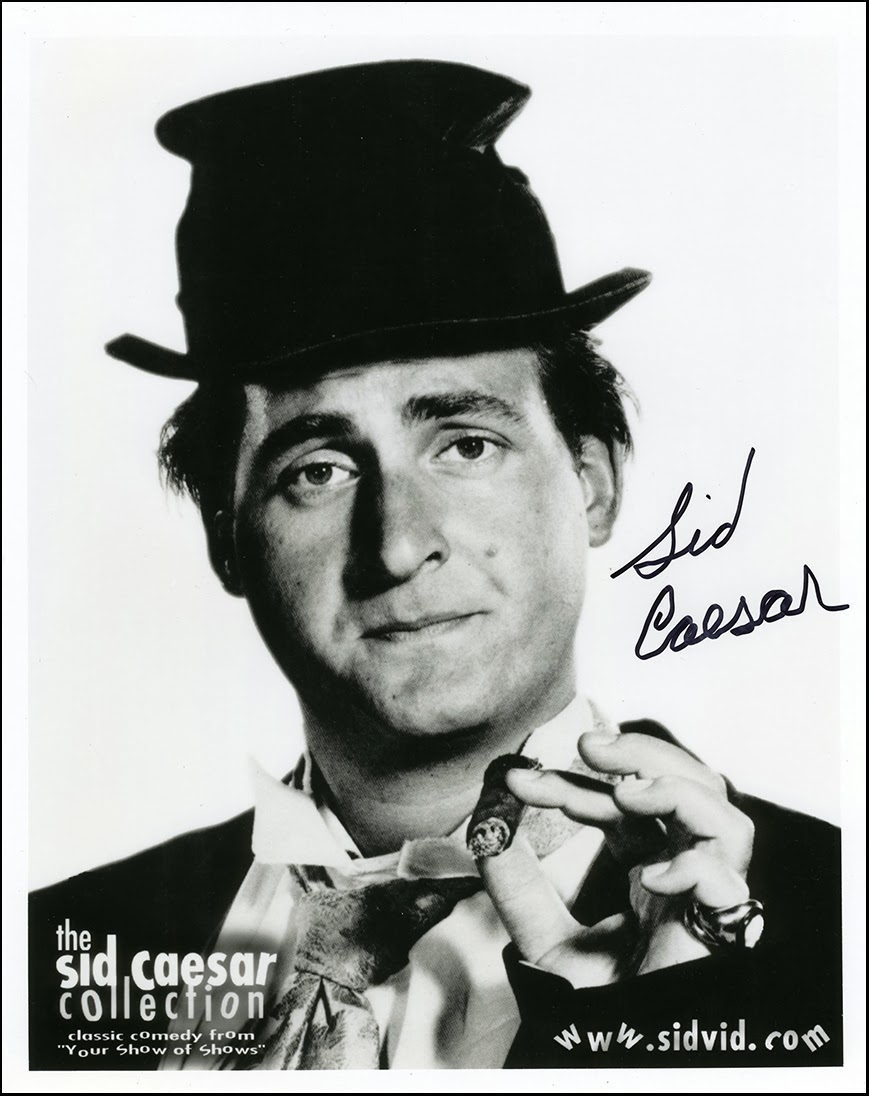
Sid Caesar 1922 - 2014

My autographed photo of Sid Caesar
I couldn't let February end without doing a post on Sid Caesar, who passed away a little over two weeks ago. Anyone who reads this blog knows I'm a huge fan of It's a Mad, Mad, Mad, Mad World and have devoted several posts to both the movie and its stars who passed away.

Strangely enough, my parents were never big fans of Sid Caesar or Your Show of Shows. Dad preferred Ernie Kovacs and his zany brand of comedy. He also thought Jackie Gleason was "The Greatest."

Thus, as a kid I only knew Sid Caesar from the 1960s movies The Spirit is Willing and It's a Mad, Mad, Mad, Mad World. But that was quite enough for me to become a fan.

His character in It's a Mad, Mad, Mad, Mad World – Melville Crump, the dentist – is one of the more sympathetic and appealing ones. He and his pretty wife Monica (played by Edie Adams) are on their second honeymoon, when they are drawn into the race to find the $350,000 buried in a state park.

Crump is the rational character who tries unsuccessfully to convince the others that they should search for the money together, and share it equally amongst themselves. But he fails to convince them of the merits of his proposal, and the result is a comic free-for-all.

What makes the Crumps' segments of the movie so funny is the fact that unlike the other treasure hunters, they are a true husband-and-wife team. The married members of the audience can identify with the Crumps as they end up in ridiculous situations of their own making. What husband can't relate with Melville Crump, watching him fail – hilariously – time and time again in front of his adoring wife?

Here's a selection of scenes from It's a Mad, Mad, Mad, Mad World featuring Sid Caesar and Edie Adams as Melville and Monica Crump. Check out Caesar's great facial expressions.


Crump scoffs at his wife's suggestion that the dying man who told them about
the $350,000 might have been a practical joker
Crump tries to explain to a skeptical Lenny Pike (Jonathan Winters)
why the buried money – if they find it – would be tax-free
Trying to get there first, it's up, up and away as the Crumps
are ready to take off in the 1916 biplane piloted by actor Ben Blue
The Crumps manage to get themselves locked in the basement
of a hardware store; they spend much of the film trying to get out
After blasting their way out of the basement with dynamite, the Crumps
hire a cab driver played by Peter Falk – once they get him off the phone
Near the end of the movie, after falling from an out-of-control fire truck ladder,
Crump crashes through a window and down a flight of stairs
Sid Caesar came to Northeast Ohio back in July of 1981 when he appeared at the Front Row Theater with his old Your Show of Shows co-star Imogene Coca in "With a Touch of Burlesque." The revue was later filmed and shown on cable television.

Caesar and Coco recreate a sketch from "Your Show of Shows" for "With a Touch of Burlesque"
Anyway, it's been sad to watch the great comedians of the 1950s and 60s slowly pass away, especially the stars of It's a Mad, Mad, Mad, Mad World.

Sid Caesar, one of the earliest and greatest TV giants, will be missed.

Thursday, February 27, 2014

6th and Broadway – Then & Now

Add caption
I haven't done any 'Then and Nows' lately – probably because I've used up all of the most obvious (and easily obtainable) ones! (Either that or everything else that I have an old photo or postcard of has been torn down – so there's no "Now" to shoot!)

So that means that I have to start scraping the bottom of the barrel and really dig to find some to do – which leads me to this one. It's a photo of the Lorain Banking Company from an ad that ran in The Lorain Journal back on Saturday, July 18, 1959.

Accompanying the photo was this copy providing the history of the Lorain Banking Company:

1905
54 years ago a former lake captain founded the Lorain Banking Company. He was Richard Thew, also vice-president and general manager of the Thew Shovel Company. It was natural that Mr. Thew should draw on his marine experience in selecting a trade-mark for the new bank, a ship's wheel and a lighthouse. The part that the bank will play in The Lorain of the Future is told best by the success of the many pioneer industries aided by it. The young Lorain Banking Company gave generous aid to individuals as well. Richard Thew was president of the Lorain Banking Company from 1905 to 1923, and the Thew Shovel Company grew during this time to be one of the leading companies in the United States.

The Lorain Banking Company merged with National Bank of Lorain to form Lorain National Bank in 1961.

And here's the uncropped "now" shot (actually from last year – before the snow hit).

The building looks to be in great shape (although I am not crazy about the sign obscuring the original inscription). It houses several attorneys and law firms, including Anthony Baker, Javier H. Armengau, J. Anthony Rich, Zachary B. Simonoff, Paul A. Griffin Co., L.P.A., John P. Kilroy, James J. Paterson, Susan Cruzado Burge and Bevan & Associates L.P.A., Inc.